Kelly's Heroes

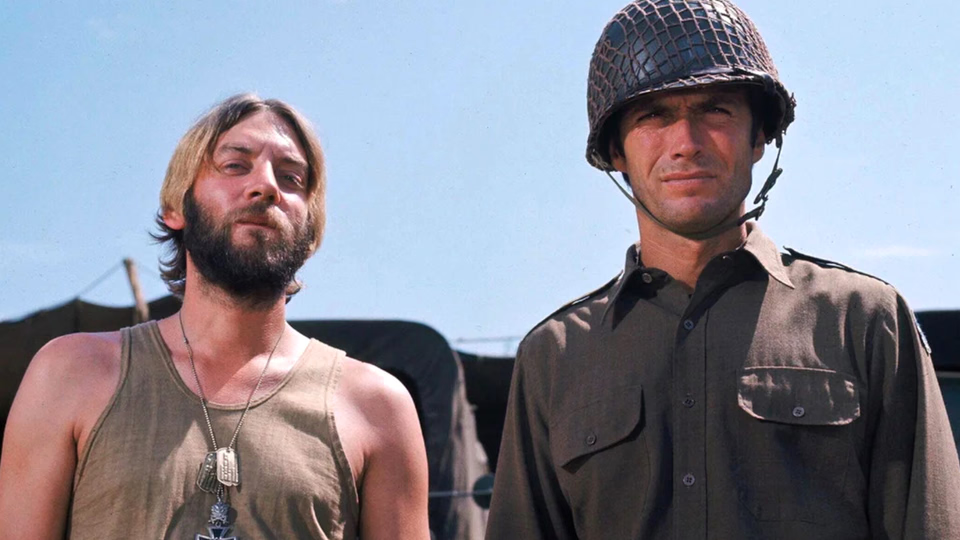
Here is a premise so good it ought to have been bulletproof. Clint Eastwood plays a private named Kelly, busted down from lieutenant because the brass needed a scapegoat for an infantry assault that went badly. In the first twenty minutes he gets a captured German colonel drunk and learns there is a bank vault thirty miles behind enemy lines with enough gold in it to make every man in his platoon rich. It is 1944, the Normandy landings are weeks behind them, and the war has just become a business opportunity.
What Kelly does next is assemble a crew, which in a heist picture is the fun part. Don Rickles turns up as Crapgame, a supply sergeant who runs the European theater as a private commodities exchange. Donald Sutherland is Oddball, a tank commander who speaks in a beatnik drawl, mounts loudspeakers on his Sherman to unnerve the enemy, and asks his men repeatedly not to hit him with those negative waves. Telly Savalas plays Big Joe, the master sergeant, who wants no part of it until he understands that his men are going anyway, at which point his job becomes keeping them alive.
The cast is the reason this movie survives. Eastwood is Eastwood in a role that asks nothing more of him and demands nothing less. Savalas is a revelation. Shirtless, lean, bawling at his men in a voice that has been sanded down by five hundred cigarettes, he stands opposite Eastwood and does not blink. Sutherland is a delight and would have walked off with the picture if two other stars weren’t standing on the corners of it. He may have walked off with it anyway. His first scenes opposite Eastwood, in which two entirely different acting styles regard each other with polite bewilderment, are the best in the film.
The production is the other reason. It was shot in Yugoslavia with real tanks that roll over real stone walls, and the buildings that explode were bought so they could be exploded. The mud is real mud, and the whole thing passes for occupied France without argument.
The trouble is that a heist needs a clock. You can imagine the Rat Pack making this a decade earlier, with Sinatra as Big Joe and Martin as Kelly.1 As indulgent as those pictures were, they still moved. The plan, the job, the getaway, always with somebody’s watch ticking away. Kelly’s men set out for the bank and will arrive when they arrive. So the film lurches. It builds a head of steam, spends it, then has to start the engine again. This happens early. Right after Kelly learns about the gold, artillery comes down, tanks come on, things burn in the dark, and you settle in thinking the chase has begun. Instead the platoon pulls back to a quiet village and the movie sits down to introduce more characters.
The action, when it comes, is first-rate. Oddball’s tanks take a German railyard apart, and the finale is a lovely cat-and-mouse through the narrow streets of the bank town, ending with Eastwood, Savalas and Sutherland walking down a street toward a Tiger tank while Lalo Schifrin does an impression of Ennio Morricone. But director Brian Hutton keeps cutting away from the good stuff. At one point we spend an eternity with Carroll O’Connor as a general listening in on the radio, wide-eyed, previewing Archie Bunker, while offscreen Kelly loses two tanks. I would rather see the tanks.
There is also a Vietnam picture hiding inside the caper. The Mike Curb Congregation sings folk-pop over the opening credits, Oddball’s crew lounges around like a commune, and the Germans are treated as obstacles rather than as the people who built the camps. The film wants slobs against snobs and can’t quite square that with the war it happens to be set in. Altman’s M*A*S*H, out that same year, wisely opted for Korea.
And the logic collapses if you poke it. The platoon leaves without the tanks and crosses an open plowed field behind enemy lines in broad daylight. When they meet the tanks, they discuss the whole scheme over an unsecured radio. Gaps like these might go unnoticed in a brisker movie. This one gives you time to notice.
MGM cut a good deal out, which is astonishing, since what remains runs nearly two and a half hours. Kelly’s Heroes survives on its cast and its scenery, and it survives well. I can’t recommend it, but I can tell you it’s about as good as an okay movie gets.
Footnotes
-
Frank would never have taken second billing, so they’d have retitled it. ↩︎