Jeopardy

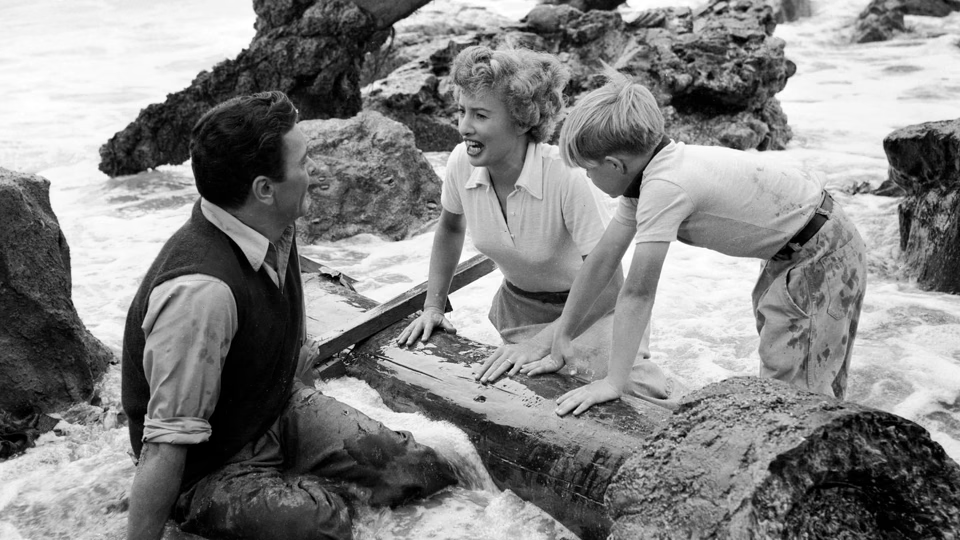
The first half-hour of Jeopardy is so ordinary that I can imagine a whole generation of television viewers giving up on it around the third time Barry Sullivan talks to Barbara Stanwyck like she’s a child. I do not fault them. But there is a much better movie hiding inside this one, and it arrives in the person of Ralph Meeker, wearing a stolen shirt and a grin that suggests he has read the script and knows he’s the only one having fun.
The setup is a family vacation. The family is Stanwyck, husband Sullivan, and their son, played by Lee Aaker with the relentless pep of a child actor who knows the camera is his. Stanwyck narrates as they drive down the coast of Baja California toward a fishing spot Sullivan remembers fondly from his Army days. What he remembers, and what he finds, is a canyon cove with a few abandoned shacks and a jetty that has been surrendering to the Pacific for about a decade. The boy wanders out onto it, as boys in movies must. A piling gives way. Sullivan saves the kid and ends up pinned in the surf with the timber across his leg and the tide four hours out.
Throughout, we get Sullivan explaining the world to Stanwyck with the smiling condescension of Ward Cleaver. He explains the car. He explains the gun in the glove box. He explains the tides. After he’s trapped he explains that she should take the car and find help, and Stanwyck has to say the line “You know I’m not a very good driver” with a straight face. He tells her the Spanish word for rope before she goes. She forgets it before she’s out of the canyon, and honestly, so did I.
Director John Sturges appears to find this material as tiresome as we do, and he gets through it fast. Once Stanwyck is behind the wheel and moving inland, the movie stops being an MGM domestic short and becomes something leaner. She finds Meeker: an American, sweating, pleasant, and wrong. He has recently left a Mexican jail without completing the paperwork. He takes the car. He takes the gun. He takes her. He has no interest whatsoever in driving back to a beach to rescue a stranger under a log.
What happens next surprised me for a 1953 picture. Stanwyck, who has spent thirty minutes being handed her purse, looks this man over and calculates. She takes a drag, leans back against the car, and lets him look. She is suddenly the woman who talked Fred MacMurray into murder, operating with a stopwatch running. What she offers Meeker is never said out loud. It doesn’t have to be. My guess is it got past the Breen Office because Sturges doesn’t pause over it for even a beat; he’s already cutting back to the beach.
And those cuts are what make the picture work. Sullivan with the water at his chin, keeping his voice light so his son won’t panic, sending the boy off for a canteen just to get him out of sight. Stanwyck in a car with a man who might do anything. The tide coming in on schedule. The eventual rescue involves a rope, an automobile, and a second piling used as a lever, and it is staged by a man who understands the physics involved and doesn’t care to show off about it.
Sturges made this for very little money, and the location photography gives him a real coast, real heat, and a real shack that looks like it would splinter if you leaned on it. Twenty years later the studios would spend fortunes capsizing ocean liners and setting fire to skyscrapers, and hardly any of those films generate the anxiety of one woman, one man in the water, and a horizon with nothing on it.
If you like your suspense lean and your Stanwyck dangerous, it’s sixty-nine minutes you won’t regret. Start the movie, go make some popcorn, and come back when the tide’s coming in.