In a Violent Nature

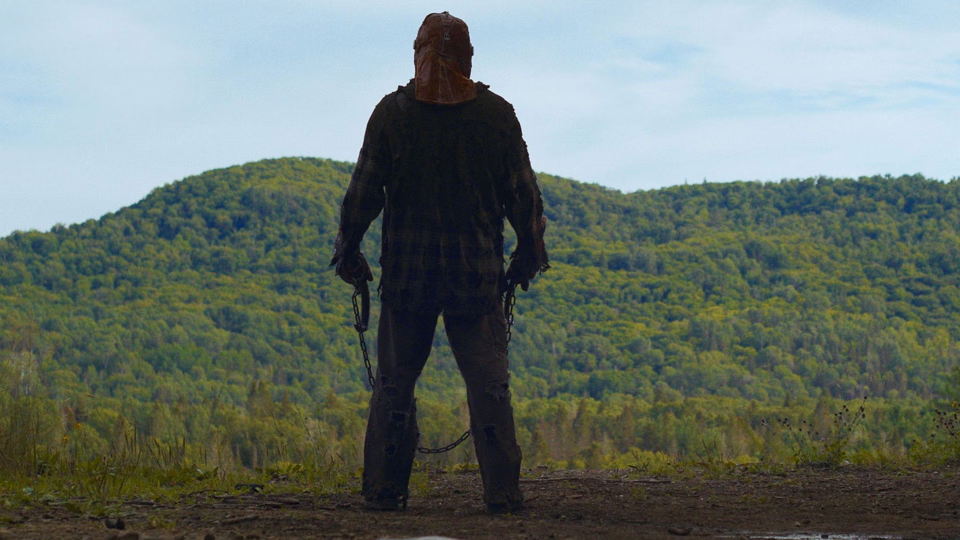
Here is a slasher film that has solved, perhaps accidentally, the genre’s oldest problem. We don’t have to spend time with the victims. In a standard Friday the 13th picture, we endure an interchangeable group of grating coeds. In a Violent Nature skips them entirely. It follows the killer instead, and the movie is better for it.
The setup is pure slasher boilerplate. Kids find a locket near a ruined fire tower in the Canadian wilderness. They take it. Something stirs beneath the earth. A large man named Johnny pulls himself from the ground and begins walking after them. He will not stop.
What writer-director Chris Nash does next is the trick. The camera settles behind Johnny at a fixed, slightly elevated angle and stays there. If you’ve played a third-person video game in the last twenty years, you will recognize it immediately. Johnny walks. The forest is gorgeous. Birds call. Wind moves through the pines. Minutes pass. More walking. It is, essentially, an ambient nature documentary with a murderer in frame.
The kicker is that somewhere out there, the rest of the slasher movie is happening without us. When Johnny finally encounters the kids, they’re mid-conversation, referencing characters we’ve never met and events we never saw. Their movie played out. We just weren’t invited.
It’s a gimmick. It is also hypnotic.
Johnny is a Jason Voorhees clone, and Nash makes no effort to hide it. Like Jason, Johnny died young through the negligence of others. Like Jason, he is a child in a man’s body. There is a quiet scene where Johnny finds a keyring with a little toy car dangling from it. He sits down. He turns it over in his hands. Then he crushes it, not understanding his own strength. It is the saddest moment in the film, and Nash doesn’t underline it.
Johnny never runs. He never varies his pace. He does not duck under branches. He moves through the forest the way a bear does, with the patience of something that has never been prey. When he approaches buildings he circles them, winding around corners, so that when he appears before his victims it seems impossible. How did he get there? He walked. He just walked a longer way around.
We must discuss the violence. It is extraordinary. In the film’s centerpiece, Johnny approaches a young woman doing yoga on a hilltop. The landscape behind her is postcard-beautiful, and Nash refuses to sacrifice the composition. Johnny walks straight toward her, the vista intact. What he does with a logging chain would be rejected from a Mortal Kombat game for poor taste. It is bloody and crunchy and wet and entirely original. There is no music. No wink. Nash plays it straight, and that is what makes it land.
Slasher fans will worship that scene. They may be less patient with the twenty minutes of walking that precede it.
This is to slasher films what Terrence Malick’s The Thin Red Line is to war pictures. The genre machinery is there, but the film is more interested in the spaces between. I suspect audiences will divide cleanly. You will either find it mesmerizing or you will check your phone.
I have nits. Johnny’s mask is too large for his frame and ruins his silhouette. He looks best early, maskless and seen only from behind, where he could double for Jason himself. And on the few occasions Nash abandons Johnny’s perspective, the spell breaks. An early campfire scene drops us in among the kids with conventional coverage, cutting between faces, circling the group. It’s competent work, but it belongs to a different film. The one we’re not watching.
But consider what Nash gets right. For most of the picture, the forest is tranquil, almost meditative. Later, when we finally follow a fleeing victim through those same woods, the soundtrack transforms. Every snap and rustle becomes a threat. The forest hasn’t changed. Our relationship to it has. Nature, Nash reminds us, was violent long before Johnny showed up.
That dissonance is the film’s thesis. It’s been there in all the classic woodland slashers, lurking beneath the tepid performances of talky scripts. Nash just strips all those distractions away. All that’s left is the beauty and the violence. He bet it would be enough.
He was right.