Humanoids from the Deep

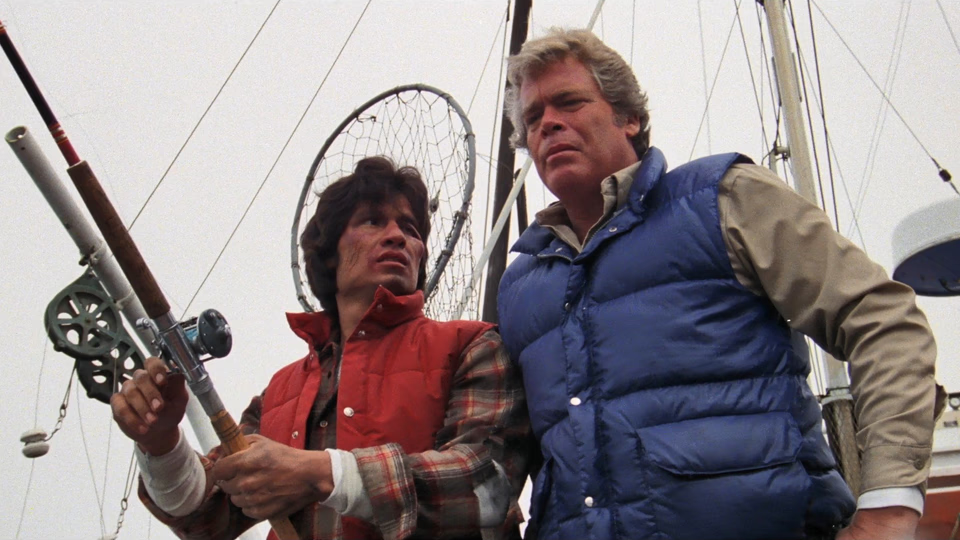
Here’s a movie that knows exactly what it is: exploitation trash with brains enough to ground its mayhem in something resembling reality.
The setup is pure pulp. Gene-spliced sea monsters bent on breeding with human women terrorize a Northern California fishing village. Director Barbara Peeters fills her canvas with weathered boats, peeling paint, and sun-baked fishermen who look like they’ve actually worked a day in their lives. The world feels lived-in. Real.
Better still, the film bothers with subtext. A corporate cannery threatens local control. Racial tensions simmer between white fishermen and Native Americans. Doug McClure plays the reasonable center. Vic Morrow radiates bigotry. These conflicts won’t get resolved—they’re shorthand to establish the characters and provide a sense of small-town politics. More relatability.
But into this verisimilitude comes the ridiculous. Early on, the film demonstrates a penchant for explosions. A fishing boat turns to splinters after the crew spills gasoline and fires a flare gun into the puddle. Natural selection at work. More explosions follow: a cabin, a truck careening off a bridge. If only they’d found a plane to destroy—they could have completed the set.
The creatures themselves prove inconsistent. An early rape scene filmed in broad daylight exposes the rubber suit in all its ill-fitting glory. Producer Roger Corman ordered these sequences shot during post-production1, and it shows. But later sequences—shrouded in shadow and slathered with mucus—work considerably better.
Consider the climactic monster assault during a town carnival. Shot at night, slimy creatures burst through the boardwalk. People die messily. Meanwhile, our heroes try dousing the water with gasoline and lighting it ablaze. This accomplishes nothing, possibly makes things worse. I appreciated that touch of futility.
At eighty minutes, the film barrels forward and simply stops rather than concluding. The battle’s won, barely, but the war continues. Life doesn’t wrap up neatly. Neither does this movie.
Some complaints: The continuity wobbles. A bikini-clad woman frolics in surf with her boyfriend while others bundle up in sweaters. Pick a season. And the “science gone wrong” explanation feels obligatory when Lovecraftian ambiguity would’ve served better. Let the horror remain inexplicable.
But judge this film by exploitation standards and it shines. The small-town atmosphere recalls Stephen King. The location photography adds texture. Vic Morrow uses a coffee cup as a beer can cozy—that’s the kind of detail that matters.
Warning: this contains graphic rape sequences, animal violence, and mutilated dog corpses. Delicate viewers should skip it. Everyone else will find a nasty, energetic monster movie that respects its audience enough to create a believable world before unleashing rubber-suited hell.
Footnotes
-
Lukeman, Adam. Fangoria’s 101 Best Horror Movies You’ve Never Seen: A Celebration of the World’s Most Unheralded Fright Flicks. United Kingdom: Crown, 2011. ↩︎