Heat

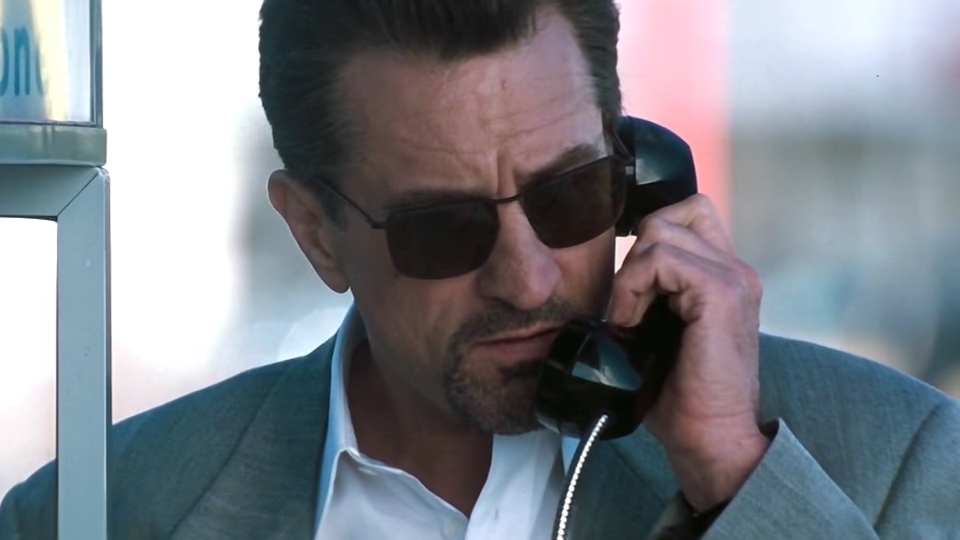
Michael Mann’s Heat runs 170 minutes and begins with a man stepping off a train in Los Angeles to steal an ambulance. Ten minutes later an armored car is lying on its side in the middle of a workday morning, three guards are dead, and one of them died only because a new man on the crew felt like shooting him. That murder is the hairline crack in an otherwise flawless job, and everything in the next two and a half hours leaks out of it.
Robert De Niro is Neil McCauley, who runs the crew. Al Pacino is Vincent Hanna, the lieutenant pursuing him. Mann spent years talking to actual detectives and actual thieves, and he sent his cast to train with former special forces men. The preparation turns up in details most directors would jettison for something flashier: the short controlled bursts, the magazine reloads, the way a man moves along the side of a car rather than over the hood. What makes the film strange and wonderful is that Mann then photographs all this procedure like grand opera. Cranes rise. Handheld cameras shove in close.
The action is the least of it. McCauley lives alone in a glass house above the Pacific with almost nothing in it, a man renting his own life month to month. Hanna chases him with a fervor that is eating a third marriage. The two men meet for coffee. You have heard about this scene even if you have not seen it, because every other crime picture of the last thirty years has tried to reproduce it, usually with two actors leaning in and posturing. What makes the original land is how ordinary it stays. Mann cuts between over-the-shoulder singles, no two-shots. They compare notes on insomnia and bad dreams. Two men who are extremely good at a job discover perhaps the only other person in the world who understands the job, and both of them know the conversation costs nothing because neither will hesitate later. Hawks would have recognized these two immediately.
Pacino plays Hanna at full volume, erupting at witnesses and suspects who look as though they’d confess to anything if he’d only lower it a little. De Niro plays McCauley in a near whisper. This is not two actors failing to agree on a key. A cop announces himself in every room he enters; a thief spends his life trying to be the man nobody remembers. Val Kilmer, as the crew member who can’t stop gambling and can’t stop loving his wife, gives the film its bruised heart, and Tom Sizemore doesn’t seem to be acting so much as occupying. Dennis Haysbert has perhaps three scenes as an ex-convict working a grill for a manager who skims his tips, and yet when the film comes back to him, you feel it.
Then there is the downtown shootout. I saw it in a theater in 1995 and was convinced the picture was over, that no one was getting out of that street. Mann recorded the gunfire live between the bank towers instead of using library effects, and the sound comes back off the glass in flat cracks that you feel in your sternum. Afterwards, I walked out jittery, like a man who’d had six cups of coffee and an argument. I have seen the film many times since and I still find myself tilted forward, heels off the floor, hands closed, not breathing.
My real complaint now is that the movie I saw in 1995 is getting harder to find. Mann has revisited Heat for nearly every high-definition release, recutting scenes, dropping lines, pushing the color one way and then another. It is not the vandalism George Lucas committed against his own trilogy, but it is a man unable to stop touching something he already got right.
See it anyway. Find the biggest screen and the oldest transfer you can. The last shot, out by the runway lights at LAX, is two professionals arriving at the only conclusion either of them ever really expected.