Double Indemnity

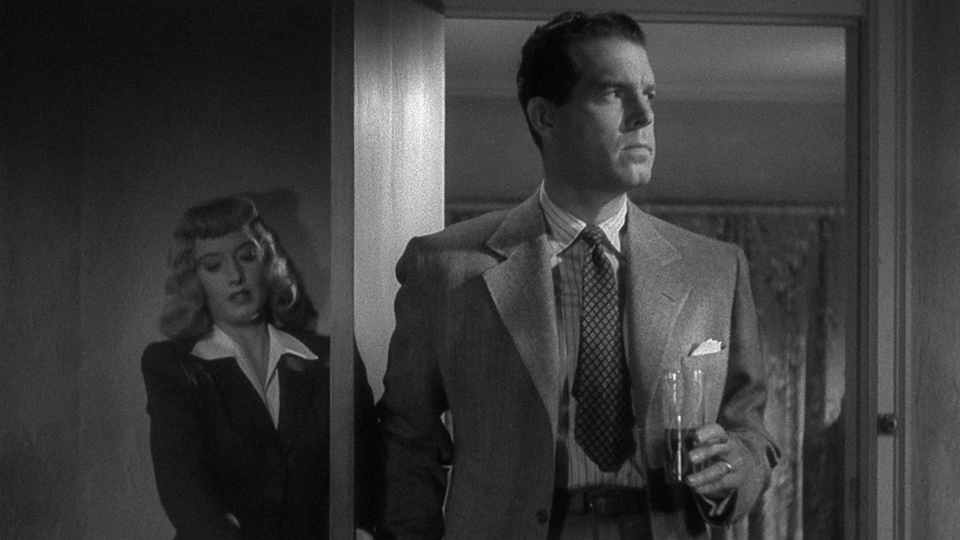
You know from the first frame that Walter Neff is a dead man. He tells you so himself, slumped over a Dictaphone in a dark office, bleeding from a gunshot wound, confessing everything. Billy Wilder isn’t interested in surprises. He’s interested in how smart people talk themselves into stupid things, and Walter Neff is going to tell us.
Fred MacMurray plays Neff, an insurance salesman good enough at his job to know every angle of a scam and dumb enough to think that qualifies him to run one. Barbara Stanwyck is Phyllis Dietrichson, the wife who wants her husband dead and his accident policy paid in full. They meet. They circle. They scheme. The husband dies. Then the real movie starts.
Wilder and Raymond Chandler, adapting James M. Cain’s novel, threw out most of Cain’s dialogue and wrote their own. Thank God. Neff and Phyllis don’t have conversations. They have bouts. She tells him there’s a speed limit in California. He tells her how to spell his name—“Two ’F’s, like in Philadelphia, if you know the story.” Every line is a jab testing the other’s guard, and neither drops it until they’re both in too deep. It works because MacMurray and Stanwyck don’t play it as naturalism. This is how people talk when they’re talking around things. Neff has photos of boxers on his apartment wall. The metaphor isn’t subtle. It doesn’t need to be.
MacMurray wasn’t the first choice, but I can’t imagine anyone better. We believe Phyllis could seduce him because we can see the decent man underneath, the one making a terrible decision and half-knowing it. MacMurray doesn’t get the flashiest lines—those belong to Edward G. Robinson as Keyes, the claims adjuster with a “little man” in his stomach who smells fraud the way a bloodhound smells rain. But MacMurray does something harder. He plays two men at once: the cocky salesman narrating his confession and the fool who thought he was smart enough. Watch his face in the final scene with Keyes. He smiles, and the smile contains everything the movie has been about.
Stanwyck created something here that an entire genre has been chasing ever since. She doesn’t chew scenery. She doesn’t need to. There is a stillness to her that is more frightening than any theatrics—the calm of someone who has done terrible things before and found them manageable. We understand what Neff sees in her, which is essential. A lesser actress would play the villainy. Stanwyck plays the magnetism.
Robinson’s Keyes is the conscience of the picture, a man who loves Walter like a son and will destroy him like a professional. His speech about the statistics of suicide is a monologue other actors would kill for, and Robinson delivers it like a man thinking out loud. When Walter tells him, “Know why you couldn’t figure this one, Keyes? I’ll tell ya. ’Cause the guy you were looking for was too close. Right across the desk from ya,” he replies softly, “Closer than that, Walter.” He’s not making an accusation. He’s absorbing a wound.
Wilder and cinematographer John Seitz shot the picture as if sunshine were illegal. The Dietrichson house is a cavern. Neff’s apartment is a hole. The insurance office at night is a mausoleum. In darkness these people can be who they really are. When Phyllis and Neff meet in a supermarket, fluorescent light pouring over them like disinfectant, they can barely look at each other. The scheme only works in shadow. So does the desire.
If the film has a weakness, it’s Byron Barr as Nino Zachetti, Lola Dietrichson’s boyfriend. He exists because the plot requires him, and he exits your memory the moment he leaves the frame. In a cast this sharp, he’s a butter knife.
But that’s a quibble with a masterpiece. Double Indemnity is adapted from Cain, but it doesn’t feel like Cain. It feels like Chandler—not his Marlowe stories, but something meaner, something without a detective’s code to lean on. It makes you wish Hollywood had given Chandler more screenplays to write. It makes you wonder what he would have done with them. How many other writers defined a genre in multiple media?