Caged Heat

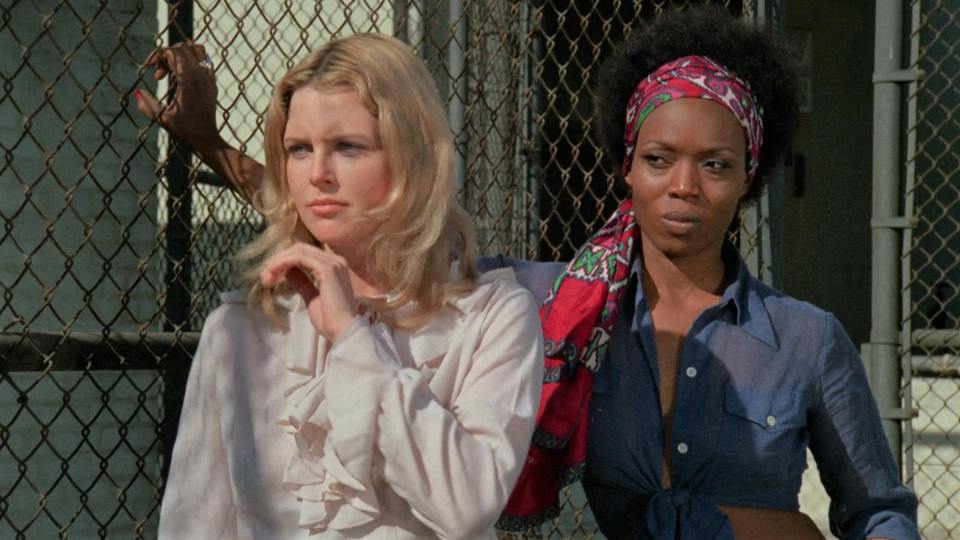
Jonathan Demme’s debut feature is a women-in-prison picture that wants to be a satire. Sometimes it is. Mostly it’s a women-in-prison picture.
The setting is a California lockup run by a wheelchair-bound warden with a talent for cruelty and a doctor whose hobbies include lobotomies and sexual assault. The inmates endure the usual humiliations. They shower. They fight. They plot escape. By 1974 this cycle had nearly exhausted itself, and Demme, who had produced for Roger Corman and understood the machinery, decided the way forward was to crank every lever at once and wink while doing it.
He delivers the goods. There is a great deal of nudity, staged with more craft than you’d expect. A recurring bit has one inmate slipping away during shower time to smuggle food to a friend in solitary. Demme crosscuts between her little covert mission and the assembly line of bodies moving through the showers, wringing genuine tension from what is otherwise contractual obligation. The climax is loaded with squibs and ambition. It reaches for The Wild Bunch and comes up short, but then, most films do.
His visual style recalls early De Palma: realism as a baseline, formal flourishes where the budget allows. Wide shots dominate, giving the picture an almost documentary flatness, but he pulls in tight when it counts. An attempted lobotomy sequence earns its close-ups.
His casting, though, is uneven. Tapping Barbara Steele for the sexually-repressed warden is genius. Those eyes could cut glass. Her British accent and glacial composure make her the best thing in the picture, and her dream sequence, a burlesque number staged in a psychedelic bathroom, is a must-see for horror fans who already love her.
Roberta Collins also registers as a kleptomaniac inmate. She’s got real screen presence and you sense she had more range than the genre ever asked of her. In a kinder industry, she might have followed Pam Grier out of exploitation and into real stardom.
Top-billed Juanita Brown is less fortunate. She has the physicality for her role, but too often her delivery feels phoned-in. When she warns Collins that she’ll “spill a can of kick-ass all over her butt,” it sounds like she’s reading it for the first time—and from a cue card. It’s a problem the movie can’t quite shake.
Neither can it shake the dead air. John Cale wrote and performed the score, but long passages play in silence, as though he were being paid by the note.
At its best, Caged Heat manages the trick of wallowing in its genre while laughing at it. One sequence has two inmates dress as men and perform a vaudeville act built on dirty jokes. “What’s a good gift for a girl who has everything? Penicillin!” Another sequence sees a gang of women burst into a currency exchange intending to rob the joint, only to discover a holdup already in progress. I laughed.
These bits suggest the film Demme was trying to make—something closer to Beyond the Valley of the Dolls, where excess becomes its own commentary. He doesn’t get there, but he doesn’t alienate genre fans either. At its worst, it’s just wallowing.
So that’s something.