Burning Paradise

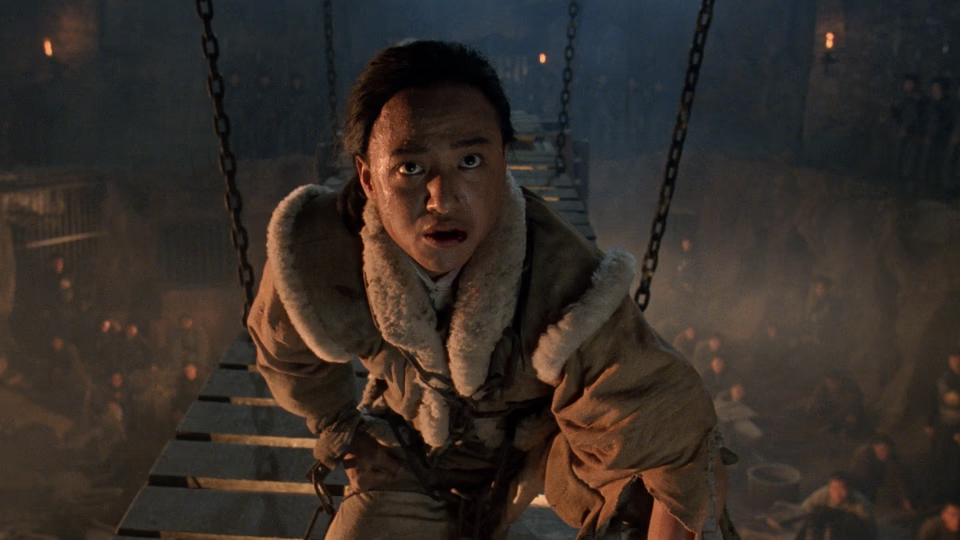
Ringo Lam’s Burning Paradise is set during the Qing dynasty’s campaign to exterminate the Shaolin monks. Young monk Fong Sai-yuk and his master flee their burning temple into the desert, where they’re sheltered by a prostitute named Tou Tou. Government troops catch up. The master is killed. Fong Sai-yuk and Tou Tou are dragged to the Red Lotus Temple, a labyrinthine underground prison where the surviving monks rot under the heel of Kung, a former general who has traded war for something he enjoys more. To Fong Sai-yuk’s fury, a fellow Shaolin serves as Kung’s enforcer. Betrayals are rarely so simple, of course.
The film has sequences that belong in a much better movie. Early on, Fong Sai-yuk hurls himself at a cavalry charge with a short broadsword and cleaves a rider clean in two. The torso tumbles to the sand. The horse gallops on. Fong Sai-yuk lands, rolls, and turns to face the rest. The choreography throughout is inventive and sometimes astonishing in its timing. And director Lam has a genuine feel for horror. Kung dispatches a servant with an abrupt slash of his bare hand, then lifts the woman’s head clean off like he’s lifting a cloche. As Fong Sai-yuk and Tou Tou arrive at the temple, we glimpse a corpse’s arms jutting from the ground, wrists slashed—hinting even suicide grants no escape. Later, the same shot to show the passage of time. The flesh has rotted away.
This is a film capable of great spectacle. So why does it feel so small?
Start with the camera. Lam made his name on the streets of Hong Kong with tight, gritty urban thrillers. He learned to shoot without master shots because he never knew when the cops might shut him down.1 That guerrilla instinct served him well in alleyways. Here it’s a catastrophe. The opening desert battle should feel epic, should convey the hopelessness of an army bearing down on one man. Instead, Lam cuts from close-up to close-up and we never grasp the scale. This was a lavish production, but the framing makes it look like he’s hiding something. He isn’t. He just doesn’t know how to show it.
There’s a scope problem too, and I mean that literally. The film was shot at 1.85:1. Historical adventure screams for 2.39:1. Imagine those desert sequences in widescreen, the horde filling the frame edge to edge, looming over our hero. In the taller ratio, achieving the same density would require pulling back, leaving vast empty sky to fill the top of the frame, diminishing the horde. Lam manages exactly one shot that exploits the frame—a caravan of troops winding toward the temple. He zooms out but fills the sky with a hanging corpse. One moment of grandeur in a film that needed a dozen.
Curiously, Lam’s limitations hurt less during the horror sequences. Horror lives in tight frames. Corridors, cells, shadows. For those scenes, his instincts are the right instincts.
Then there’s the script. The bones are solid, but the dialogue keeps cracking jokes at its own expense. During the climactic escape, as monks dodge traps and guards, someone in the crowd yells something that would get a laugh from middle-school boys. It is telling that the film plays better without subtitles.
The biggest problem is tone. Burning Paradise can’t decide what it wants to be. It aspires to the epic historical drama of Tsui Hark’s Once Upon a Time in China but injects moments of over-the-top violence and adolescent humor. This is fatal. Fans of Hark’s epics would recoil at the graphic violence. Exploitation audiences would find it tame next to something like The Untold Story. The film occupies a no man’s land, and it flopped accordingly.
Hark himself produced the picture, though “produced” may be generous. In a 2010 interview, Hark says he was originally asked to direct, was unavailable, and suggested Lam. When the budget ballooned, the studio sent Hark to rein things in, but he and Lam couldn’t agree on a vision. “Make it your way,” Hark told him, and stepped back.2 His praise for the finished film has the warmth of a form letter. I wonder what his version looked like.
Willie Chi is fine as Fong Sai-yuk. He’s no Jet Li, but he moves well and holds the screen. Wong Kam-Kong is genuinely menacing as Kung. The cast isn’t the problem. The budget isn’t the problem. The sets, the choreography, the production values—none of these are the problem.
The problem is a talented director working against his own strengths. In The Seventh Curse, Lam Ngai Choi showed how to blend action, adventure, and horror into something wild and alive. I’d say he was the man to direct this, but he’d already made his prison movie, Riki-Oh: The Story of Ricky. Watch one of those instead.