Brazil

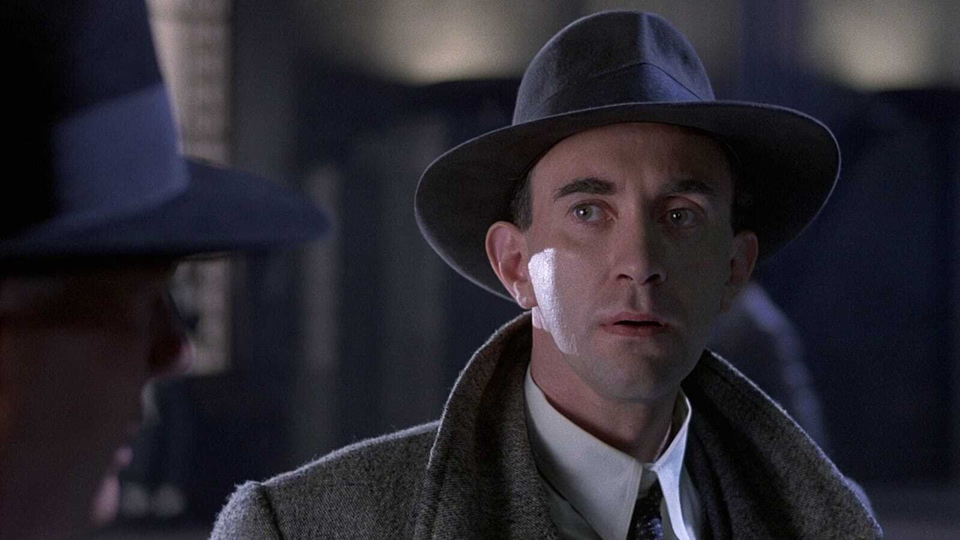
A fly falls into a teletype. A letter smudges. Tuttle becomes Buttle, and a man is dragged out of his living room for a crime committed by an insect. Terry Gilliam tells this joke in the first ten minutes of Brazil. He spends the next two hours looking for a movie to hang it on.
That arrest is a marvel. Troops burst in from every angle: door, window, even down a pole dropped from a hole sawn in the ceiling. The meager apartment can barely hold them all. Buttle is sealed into a canvas cocoon and carried off upright, a man converted into freight. His wife signs form after form, one of which, she is told, is her copy.
This is the future as it might have been dreamed in 1938, all concrete slabs and cold cathedral lobbies, everything fed by ducts that swell and gurgle behind the plaster like an animal digesting. Office computers are enormous, and their screens are the size of a postcard, so every clerk works behind a magnifying lens bolted to the front. Propaganda posters remind us that suspicion breeds confidence. There is paperwork for the paperwork, and somewhere in the building, I assume, a department that audits the paperwork about the paperwork.
Jonathan Pryce plays Sam Lowry, a clerk with a nice flat, a nothing job, and a mother wired into the top of the government. He dreams he is a winged knight rescuing a blonde in chiffon to the tune of Ary Barroso’s samba, which gives the picture its name. Then he sees the blonde driving a truck. She is Jill, played by Kim Greist, and to find her address he takes the promotion he has been ducking, into Information Retrieval, the department that stages the interrogations. Yes, the romantic hero of this film joins the secret police to run a background check on a woman he has never met.
What follows is where the movie loses me. Sam tracks her down, forces his way into her truck, orders her to drive, and tells her to trust him because he loves her. For a few minutes Greist plays it correctly: she thinks she has been carjacked by a lunatic. Then she softens, because the script has run out of second act. By the end Sam has gotten men killed, wrecked a fair amount of public property, and become precisely the terrorist his office was built to catch, and when the bill arrives he cries for his mother. As a portrait of a spoiled boy discovering the word “no,” it is devastating. As the little-man-against-the-machine parable its reputation promises, it does not hold up.
I’m being hard on it, and I don’t think Gilliam intended any of this. I don’t think Gilliam intended much of anything, narratively speaking. Listen to him talk about the picture and you hear a man who arrived at a story by walking backward out of a pile of images. He hired Tom Stoppard to impose order, and you can hear Stoppard in the good lines. Sam sends regards to an old friend’s wife and twins. “Triplets,” the friend says. Sam: “Triplets? God. How time flies.”
There are scenes here I would not surrender. Robert De Niro turns up as Tuttle, an outlaw whose crime is repairing your heating without the requisite forms, and he’s so alive on screen that you resent every minute he’s gone. A restaurant serves haute cuisine as gray scoops beside a photograph of the dish, and when a bomb goes off across the dining room the waiters simply pull a screen around the rubble and the diners keep chewing. A plastic surgeon peels Sam’s mother toward eternal youth while her friend’s face goes bad in the other direction. Carolers under a banner reading “Consumers for Christ.” None of it advances a thing, and all of it is the reason to watch.
But at 142 minutes, the picture is exhausting. Gilliam admits he was feeling his way, trimming Jill down in the editing room to make room for his inventions. When the central relationship is the thing you’re pruning, the alarm should sound. Still, less is not more. Universal hacked out a 94-minute Love Conquers All version with a happy ending. Track it down if you want to see how much worse this could have gone.
The length is a symptom. Two years later Paul Verhoeven made RoboCop, which is a cheerful, vicious cartoon about a fascist future, and it works because Verhoeven hung his satire on one man’s search for his humanity. Gilliam had the better eye but no compelling story. He could have built this on a romance, but would have had to start with one.