Braindead

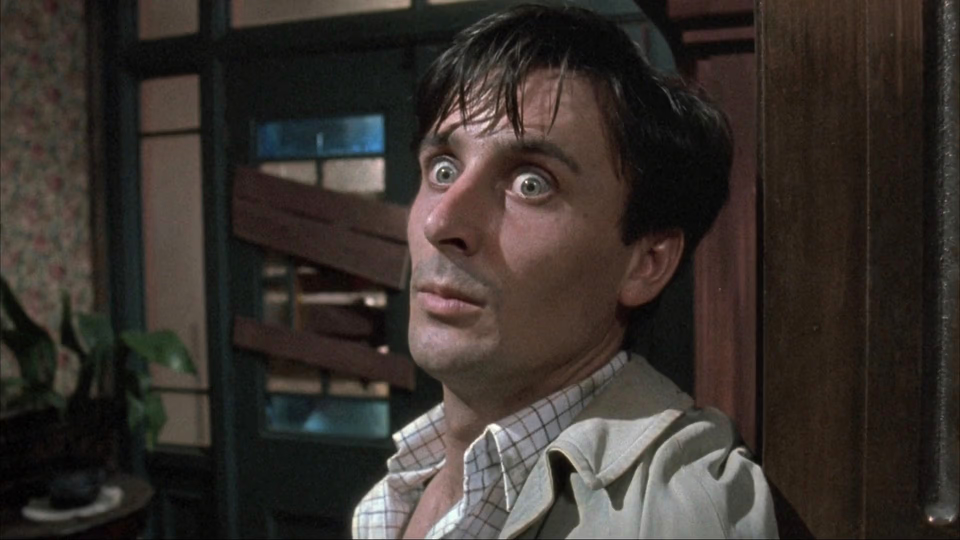
Wellington, New Zealand, 1957. A shy young man named Lionel lives under the thumb of his mother. He meets a girl. Things are looking up. Then mum gets bitten by a rat-monkey at the zoo and turns into a zombie.
Peter Jackson’s third feature arrives as the offspring of Stuart Gordon’s Re-Animator and Sam Raimi’s Evil Dead 2, and it outdoes both in technical execution while falling just short of either in pure entertainment. This is a film of enormous craft and infectious good humor, one that misses greatness by inches.
The rat-monkey (origin Skull Island, wink-wink) is a wonderful creation, brought to life through stop-motion animation that has real personality. When it sinks its teeth into Lionel’s mother, what follows is a slow decomposition played for comedy. There is a scene involving custard that I will not describe. You will know it when you see it. You may wish you hadn’t. The film has the spirit of a man who cannot believe what he is getting away with.
Timothy Balme plays Lionel as a perpetual klutz, forever knocking things over, tripping, stumbling. He injects his mother with enormous syringes of tranquilizer to get her through her own funeral, which leads to a sequence where he appears to be doing something unspeakable to her corpse that left me howling. Soon he’s digging her up, losing control, and trying to domesticate a growing population of zombies in his basement. He serves them lunch. It does not go well.
In these early passages, you can almost picture Jeffrey Combs in the role. The giant hypodermics, the stubborn refusal to acknowledge catastrophe—it’s pure Re-Animator. Later, when Lionel is trying to flee a zombie horde while standing in a pool of blood, his feet spinning uselessly like Wile E. Coyote’s, you think of Bruce Campbell. Jackson is drawing from both wells.
And yet Balme never seizes the screen the way Combs and Campbell did. Here is the paradox: he has the better role. Lionel gets a genuine arc, from kept mama’s boy to capable hero. Combs and Campbell never had arcs. They had personas. They sacrificed narrative journey for the freedom to become iconic. Jackson structures his film as a love story, which means the characters must travel a predictable road. The surprises come not from who these people become but from what explodes around them. When Lionel finally goes on the offensive, you’re not shocked. You’ve been waiting. That he does so by wielding a lawnmower like a Gatling gun—now that catches you off guard.
The supporting cast nearly closes the gap. Stuart Devenie plays a priest who knows kung fu and gets the film’s most quotable line. Ian Watkin is gloriously repellent as Lionel’s scheming uncle. Freed from the love story’s obligations, both characters can simply be themselves, and they steal every scene they wander into.
None of this should suggest Braindead (Dead Alive in the USA) is merely adequate. It is a very good movie. Jackson never rubs your nose in the gore. You can feel him cringing alongside you at the custard, cackling during the lawnmower massacre, and giggling throughout at his own audacity. Indeed, there’s a slapstick warmth to the violence that makes you want to watch it again the way you’d rewatch a favorite cartoon.
It falls just short of its inspirations because those films had iconic characters, while this one has iconic set pieces. In the end, you don’t remember Lionel, but you remember the lawnmower. That’s more than most movies.