Bela Lugosi Meets a Brooklyn Gorilla

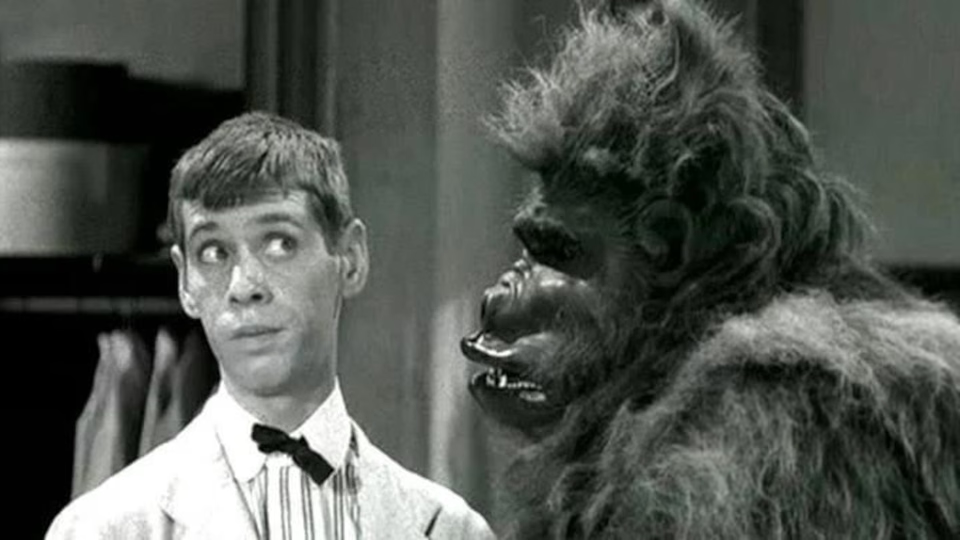
On a South Pacific island, the natives come upon two men asleep in the jungle, shaggy and bearded and wearing tuxedos that have seen better nights. The men are carried to the village, bathed, shaved and barbered, and when the towels come off we are looking at Martin and Lewis. Then we look again. They are Duke Mitchell and Sammy Petrillo, playing characters named Duke Mitchell and Sammy Petrillo, and they explain that they fell out of a plane on the way to entertain the troops on Guam. Nobody asks how a person falls out of a plane. On this island, nobody asks much of anything.
Mitchell was born in Farrell, Pennsylvania, about an hour and a half up the road from Martin’s Steubenville. He has Martin’s haircut and a pleasant baritone, but beyond that he is his own man. Petrillo is another matter. He is doing Jerry Lewis, the honk and the whine and the knock-kneed panic, and he does it well, which is the problem.
I have never warmed to Lewis. I like Martin enough to have tried some of the Martin and Lewis pictures, and Lewis drove me out of each of them. When Kurt Russell played John Wayne playing Jack Burton in Big Trouble in Little China, or Johnny Depp let Keith Richards wander through Captain Jack Sparrow, you could see the actor behind the borrowed persona, enjoying himself. There is no daylight between Petrillo and his model, so I disliked him for the same reasons I dislike the original.
Duke falls for Nona, the chief’s daughter, who went to college in America and can therefore speak idiomatic English, explain local customs and save the screenplay a good deal of trouble. Her sister Saloma, large and determined, sets her cap for Sammy. Nona works for Dr. Zabor (Lugosi), who has been perfecting a serum that sends living things backward down the evolutionary ladder and who does not like the way Duke looks at her. You can guess where this is headed.
There are curiosities. Sammy is called “the little one,” though he is as tall as Mitchell and about as wide. After Duke becomes a gorilla and loses the power of speech, he proves who he is by crooning a ballad. With a gentler sidekick I might have surrendered to the nerve of it. I will confess to one laugh. Sammy calls his partner “Dukey.” Say it aloud in a Jerry Lewis whine. I am not proud.
Lugosi’s name is above the title, but he is on screen for maybe a quarter of the picture. Only four years earlier he played Dracula in Abbott and Costello Meet Frankenstein, yet here his face is gaunt, his teeth are stained, and he looks twenty years older. He was nearly seventy. He leers, he sneers, he delivers long paragraphs of pseudoscience in that voice, and he does it with real energy. He isn’t slumming. He simply isn’t given much to do.
The director was William Beaudine, known around Hollywood as “One Shot,” and he had nine days and about $50,000.1 Within those limits the film is competently photographed and cleanly cut, and it keeps moving. Next to Lugosi’s other 1952 release, the British Vampire Over London, it looks like a prestige production. Hal Wallis, who produced the real Martin and Lewis pictures, is rumored to have tried to buy the negative so nobody would see this one. He failed, and you can decide whether he should have succeeded.
If the premise made you grin, you will probably have a fine time, and you may find Petrillo’s Lewis uncanny in the good sense. If you share my allergy, the running time will feel a great deal longer than it is.
Footnotes
-
Arthur Lennig, The Immortal Count: The Life and Films of Bela Lugosi (Lexington: University Press of Kentucky, 2003), 386, Kindle. ↩︎