Ball of Fire

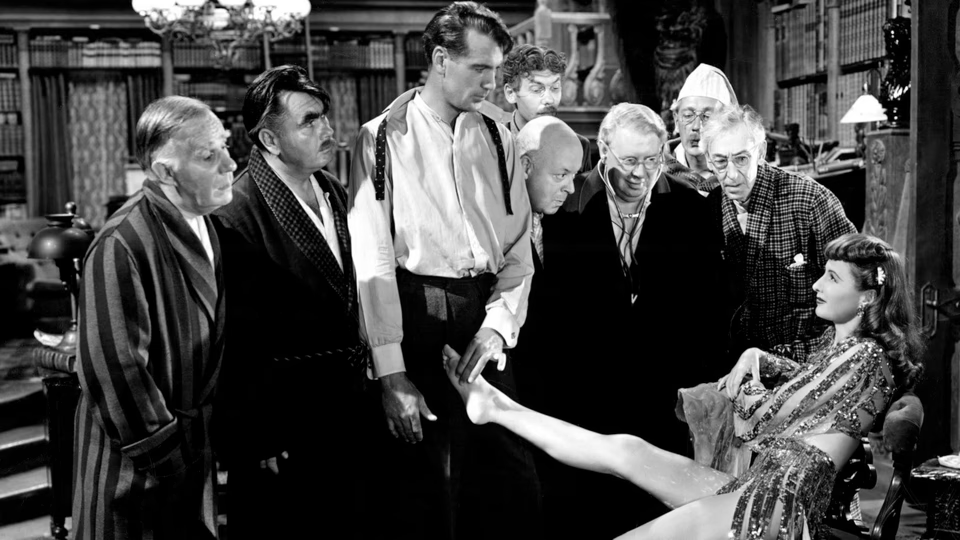
Howard Hawks’ Ball of Fire is Snow White in Manhattan, with seven elderly professors instead of dwarves and a nightclub singer instead of a princess. The allegory isn’t subtle. Gary Cooper, at six-foot-three, towers over his fellow academics like a beanpole among mushrooms. But the real magic trick is that Billy Wilder and Charles Brackett’s script keeps inverting who’s saving whom. She saves him from a life buried in books. He saves her from being a gangster’s accessory.
Cooper plays Bertram Potts, an English professor and the youngest member of a team of scholars grinding away at an encyclopedia in a mansion that doubles as their monastery. They take constitutional walks. They debate. They have not, apparently, spoken to a normal human being in years. When Cooper can’t make heads or tails of the garbage man’s slang, he ventures into the city to assemble a working group of real people who talk like real people. One of his recruits is a nightclub singer named Sugarpuss O’Shea.
Barbara Stanwyck plays Sugarpuss, and she is the reason to see this picture. She’s hiding from the cops, who want to ask her pointed questions about murders committed by her fiancé, a mobster played by Dana Andrews. She invites herself into the professors’ home, and they never stood a chance. Neither do we.
Stanwyck makes Wilder’s slang feel lived-in, not recited. She wins over every character onscreen without a single teary monologue or melodramatic plea. When the professors’ landlady threatens to blow her cover, Sugarpuss doesn’t panic. She decks the broad and stuffs her in a closet. I cackled.
The professors blur together, as Hawks intended. “I always thought of them as one actor,” he said. Fair enough. But when that one actor is built from Henry Travers, S.Z. Sakall and Oscar Homolka, it’s a pretty good actor. There is a scene where they attempt a cha-cha, patterns drawn on the floor, having worked at it since lunch. It is a small masterpiece of comic timing. So is the later bit, when Travers accidentally triggers a machine gun and hangs on for dear life.
Indeed, Hawks had a gift for casting people who didn’t seem cast. Kathleen Howard, as the landlady, convinces with a look. Elisha Cook Jr. turns up as a waiter and somehow feels like he’s been carrying trays his entire life.
Which brings us to Cooper. He’s the film’s one soft spot. He isn’t miscast the way he would be in Love in the Afternoon, and he’s far from a disaster, but he’s the only one who seems to be acting. During production he complained to Hawks that some of his dialogue was too complicated. You can feel it. Every other performer in the picture inhabits their role; Cooper performs his.
The whole picture was driven by producer Samuel Goldwyn, who was tired of Cooper’s biggest hits coming on loan to other studios. He paid Wilder $79,000 to write a star-vehicle, and when nothing in Goldwyn’s development folder suited him, Wilder dusted off an old story about a British professor and rewrote the lead as a shy American.1 Cooper chose Hawks to direct. For the female lead, Goldwyn’s first two picks—Ginger Rogers and Carole Lombard—turned it down. When Harry Cohn refused to loan out Jean Arthur (who Hawks didn’t want anyway), Cooper suggested his Meet John Doe costar, Stanwyck.2 Thank goodness.
Though Cooper was a foregone conclusion, one wonders what might have been. Cary Grant, perhaps? The original story had the professor as British. But Grant had just played an academic in Hawks’ wildly successful Bringing Up Baby. Maybe Fred MacMurray? Or Henry Fonda? We’ll never know. Wilder, who wrote into his contract the right to observe on set every day—preparing for his own jump into the director’s chair—might have had ideas about that too.
But Stanwyck is here, and Stanwyck is enough. By the final act, the emotional stakes had eclipsed the narrative ones. I knew where the story was going. I didn’t care. She’d already won me over, same as she won over those professors, one slang lesson at a time. The picture runs a touch long. Cooper is merely okay. But Ball of Fire has warmth, wit and Barbara Stanwyck. Two out of three would have been enough.