At the Earth's Core

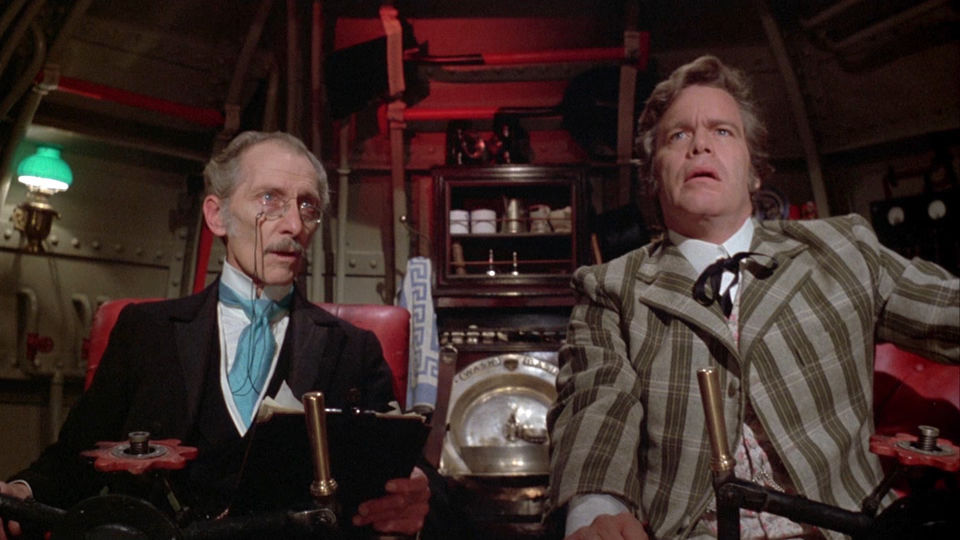
In the first ten minutes there is a shot of a Victorian drilling machine, all brass and rivets and a spinning iron nose, and it is a beauty. The miniature work is good. Peter Cushing, buttoned into a waistcoat as Dr. Abner Perry, is better than good. For a few minutes I thought Amicus had gotten up a Jules Verne picture the whole family could sit through.
Then the monster arrives and I remembered which studio I was watching.
Doug McClure is David Innes, the American money behind Perry’s Iron Mole. The machine misbehaves and the two men punch through into a world beneath our own. A bird-headed thing the size of a delivery van objects to their arrival, they run, and they are promptly taken prisoner by the Sagoths, apemen who keep human slaves on behalf of the Mahars, flying lizards who govern by telepathy and a lot of unblinking.
Director Kevin Connor introduces that first creature beautifully. He shoots from below, uses projection to make it loom large, and for about fifteen seconds it works. Then he cuts in for a closeup, and the fabric wrinkles at the knee, and there stands a stuntman sweating inside forty pounds of latex.
That’s the whole movie. One shot lands, the next collapses, sometimes within the same scene.
Somebody in the art department understood that if you cannot afford to be convincing, you can at least afford to be gorgeous. The underground world of Pellucidar is all magma glow, violet sky, and hothouse foliage in shades that don’t occur in nature or anywhere near it. And the vocal effect for the Sagoth tongue is inspired: something like a dolphin run through a vocoder on a delay. Organic and mechanical at once. It got under my skin.
Cushing is essentially reprising his Dr. Who, the elderly inventor without a lick of self-preservation, which figures, since Milton Subotsky wrote those too. But here he’s the sidekick, and he vanishes for a long stretch of the middle. He’s broader, clumsier, teetering into things, brandishing his umbrella at a fifty-foot carnivore and shooing it like a pigeon off a windowsill. He is, for most of the running time, a liability. Then, late in the film, he lashes his eyeglass strap to a stick, builds a bow, and takes down a fire-breathing lizard. Where has this Cushing been hiding?
Cushing fans will notice something else. Since his wife’s death in 1971 he has been rail-thin and hollow in nearly everything, giving fine performances from behind a pane of glass. He’s still thin here, but the eyes are alive. Maybe comedy let him disappear into the part. Maybe it’s the relief of not having to carry the thing.
McClure is fine. He wears the Victorian collar like a man in a rented tuxedo, but once he’s stripped to the waist and wielding a spear, he’s at home. His jaw does most of the acting required.
Less fine are the plot holes. Everyone in this underground world speaks English, yet Perry is put to work in a library where the books are written in an alien alphabet that he can somehow read and write. Never explained. In the finale, the natives use their new bows to pick off Mahars like fish in a barrel, yet leave the head Mahar alone for no reason anyone bothered to supply. “Shoot him!” is the kind of sensible suggestion kids would shout at the screen. They notice this sort of thing.
At the Earth’s Core is a disappointment, but livelier than either of the Dr. Who films Cushing made. It moves and is cheerful about its own poverty. If you have affection for cheap adventure pictures, you will have a decent time, so long as you can forgive the seams. Cushing’s admirers should see it for the bow, then spend the ride home wishing the script had given it to him earlier.