Withnail and I

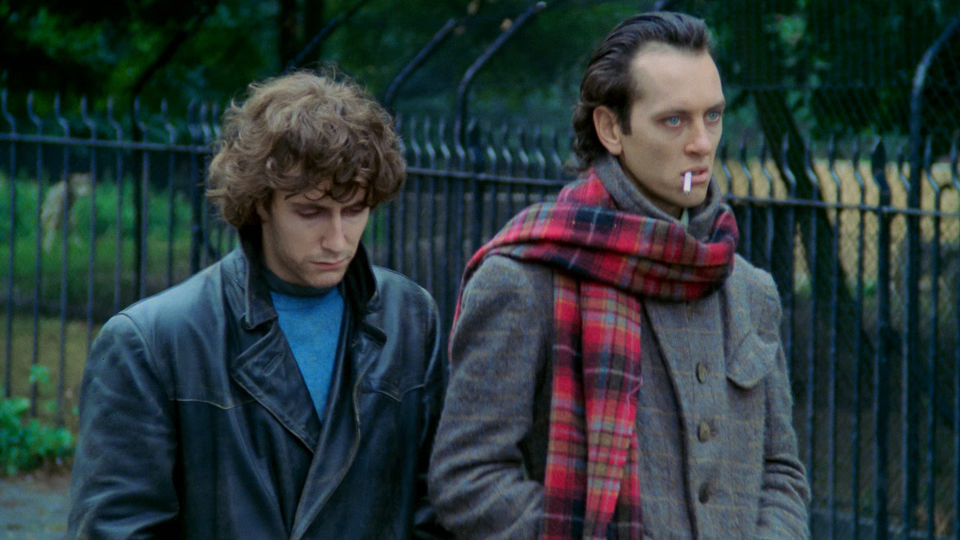
There is a sink in this movie that should have been reported to the authorities. It sits in a Camden Town flat in the last weeks of 1969, holding several days of dishes and something that may once have been a chicken, and neither of the two men living there will go near it. Nobody invents a sink like that. You have to have washed in one.
The two men are unemployed actors and, as the film opens, are coming down after having been awake for days, drinking, smoking, and taking whatever. One of them announces in a panic that his thumbs have gone weird. That is Marwood, played by Paul McGann. His flatmate offers no medical opinion. His flatmate has problems of his own.
The flatmate is Withnail, played by Richard E. Grant in a performance that astonishes. He gives us a great classical actor who has never been cast in anything, and who compensates by performing his own life at full volume for an audience of one exhausted roommate. The voice is magnificent. There is a scene where he is drunk in a tearoom demanding “the finest wines available to humanity.” It carries the conviction of a papal bull, and it is funnier because you can hear the Old Vic career he will never have. He is monstrous. You would follow him anywhere for about forty minutes.
The plot, such as it is: the two of them cadge the keys to a country cottage from Withnail’s Uncle Monty, played by Richard Griffiths, a great soft galleon of a man who quotes poetry and cooks with real butter. Bruce Robinson, who wrote and directed from his own novel, then strands them in the Lake District with no food, no fuel, and no useful skills. Withnail attempts to buy a chicken from a farmer by explaining, with the dignity of a man addressing the House of Lords, “We’ve gone on holiday by mistake.”
Grant was a teetotaler when they made this. Robinson’s solution was to sit him down with champagne and vodka so he would know the territory; Grant was promptly sick, which I suppose counts as research. Whatever it cost him, look at the motorway stop scene. Robinson gives us the shot from the policeman’s side of the glass, and Grant turns slowly toward the camera with his eyes just barely out of true. “I’ve only had a few ales,” he says, the slur sanded down almost to nothing. Then he’s hauled out of the car, leans on it, and his elbow slides off. He catches himself and stands up straight, offended, as though the car moved. It takes a second and a half. It is the best drunk acting I have seen.
McGann has the harder job and gets none of the applause. He is the one we watch through, the one keeping score, and his voice-over works when nine out of ten voice-overs don’t. He isn’t narrating. He’s remembering.
Underneath the jokes there is a funeral going on for the sixties. Hendrix is on the soundtrack, and King Curtis, and both would be dead inside two years. The Beatles had months left. Robinson lets you feel that the decade and these two men are the same story: enormous promise, poured down the drain by lunchtime. That’s a strange thing to build a comedy on. It works, because the absurdity has weight underneath it. You laugh because the other option is worse.
I should love the whole picture, but I don’t, and the reason is temperamental. A good stretch of the second act is farce. After offending a poacher at the local pub, Withnail fears the hulking man will come for them and insists on sleeping in Marwood’s bed, only for Monty to arrive and find them under the same blanket. Monty then pursues Marwood around the cottage while Withnail repeatedly abandons his friend to danger. These are screwball antics, and I have never found them funny.
Incidentally, I don’t think the film is homophobic. Marwood has a horror of buggery, established early by graffiti above a pub urinal, and the movie treats that horror as absurd. Monty is written as lonely rather than predatory, and Robinson has said he handed Monty a line once used on him by Franco Zeffirelli. The joke is on the young man doing the fleeing.
Then comes the ending, alone in the rain at the zoo, Withnail performing Hamlet for wolves who won’t be reviewing him. It is one of the great last scenes in British film, and it hits with a force that nearly won me over. Nearly. I laughed hard at this movie in places and checked the time in others, which makes it, for me, a masterpiece with a hole in it.