The Tough Ones

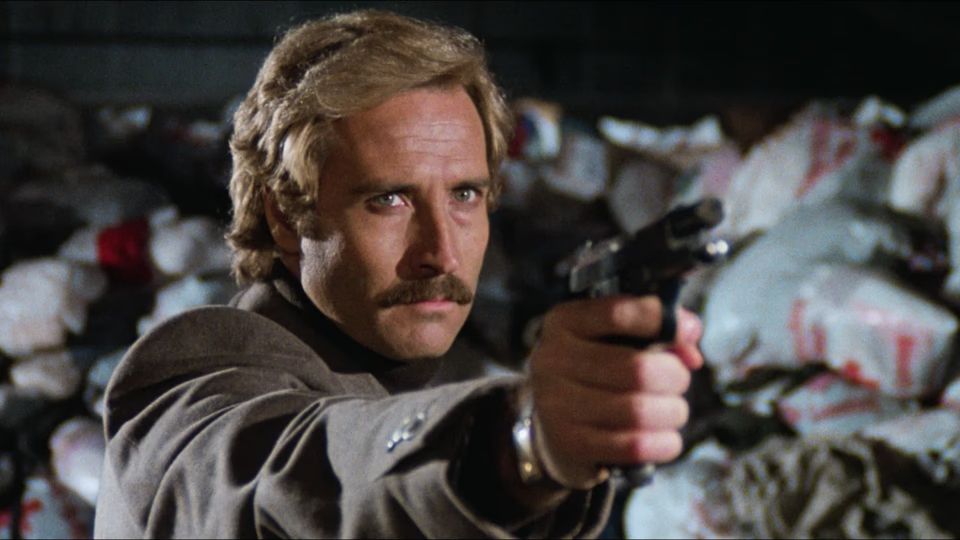
The Tough Ones plays like the first two acts of three separate movies. None of them knows what the others are doing, but they all keep moving, which counts for something.
Maurizio Merli plays Inspector Tanzi, head of Rome’s anti-gang squad, a man incapable of walking down a street without tripping over a felony. He raids an illegal casino hoping to nab Ferrender, a French kingpin. No luck. Standing outside, he spots a one-handed crook named Savelli. Savelli leads him to Moretto, a hunchback. A drug pusher named Tony wanders in from another subplot entirely. The connections between these threads aren’t so much woven as stapled.
Consider: Tanzi steps out of his girlfriend’s apartment and spots a fugitive across the street. Later, a purse snatcher fleeing the scene literally runs into Tanzi’s car. When his partner arrives, he says, “I really can’t believe they wrote the script this way.” Neither can I, but I admire the honesty.
What the film lacks in plotting it compensates for in velocity. There are no transitions because there is no time for transitions. Car chases slam into robberies that slam into interrogations. Director Umberto Lenzi treats narrative logic as an obstacle to be outrun, and for a while, you’re happy to let him.
The trouble is numbness. Tanzi spends the picture seething about a system rigged against honest cops, and you keep waiting for him to cross that Dirty Harry line. He never does. All foreplay, no climax.
Every time the film approaches genuine stakes, it flinches. Moretto’s associates kidnap Tanzi’s girlfriend and strap her into a car dangling over a junkyard compactor. Terrifying setup. Then they just let her go. She can’t identify them, conveniently, despite their naked faces. During a botched bank robbery, Savelli threatens a hysterical hostage with his gun. She wails. He raises it. Cut to outside. Gunshots. We think the worst. But no, he only fired into the air. The movie keeps writing checks it refuses to cash.
Meanwhile, an unrelated subplot about privileged university students committing a gang rape achieves a genuinely harrowing power the main storyline never approaches. It’s a strange film that saves its most disturbing image for a tangent.
And then there is the slapping. Tanzi’s preferred method of combat is the open-handed backhand. Where Callahan had his .44 Magnum, Tanzi has his palm. He grabs suspects by the collar and delivers a fusillade of slaps that starts out visceral and ends up resembling a French farce. I’d propose a drinking game, but couldn’t live with the casualties.
Still, the film is not without its pleasures if you know what you’re looking at. Lenzi shoots Rome beautifully. The film has that lived-in quality familiar to anyone who’s spent time with Italian exploitation pictures, where budgets demanded real locations and those locations kept showing up film after film like repertory actors. It gives the whole thing a strange coziness, like revisiting an old neighborhood.
And Merli may look like Franco Nero on a tighter budget, but he commits fully to the stoic, mustachioed fury, and that goes a long way. Tomas Milian, as the sadistic Moretto, provides the kind of oily menace every cop picture needs. Arthur Kennedy even turns up as Tanzi’s commissioner in one of those casting choices that only Italian genre cinema would attempt with a straight face.
It’s curious this arrived so late after Dirty Harry and Magnum Force, which had already drawn the blueprint. Maybe the poliziotteschi cycle had burned through the standard formulas by 1976, and screenwriter Dardano Sacchetti was groping for new structures. Or maybe he cannibalized three unfinished scripts to meet a deadline. Either explanation fits the evidence.
An interesting experiment, then, but not a successful one. I suspect a second viewing might play better if you abandon all expectations and treat it as a hangout movie, just spending time in Rome with Tanzi and his inexhaustible supply of criminals. There are worse ways to spend ninety minutes. There are also better ones.