The Man Who Fell to Earth

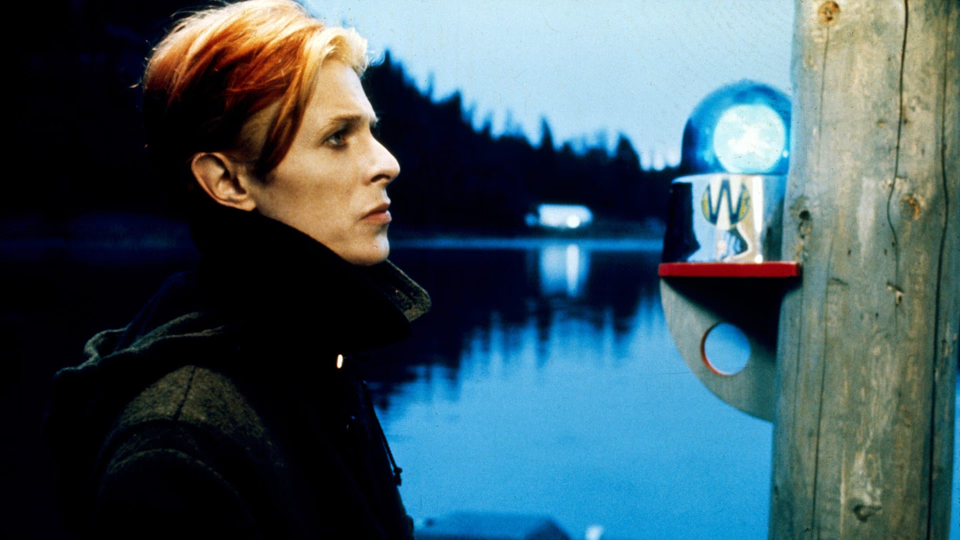
Nicolas Roeg cast David Bowie in 1975, when Bowie was living on milk, bell peppers and cocaine and weighed roughly as much as a folding chair. No makeup necessary. The camera looks at him and finds a creature who has never once been comfortable inside a human body. Best effect in the film, and it cost the production nothing.
The story, if we agree to call it that: Bowie plays Thomas Newton, a visitor who arrives in rural New Mexico with a bundle of gold rings. He sells them one at a time. The rings buy Buck Henry, a patent lawyer with eyeglasses thick enough to stop small arms fire. Newton hands him a folder of inventions from home, and next thing we know, the two of them are running one of the richest corporations on the planet. Then Newton liquidates the whole thing to build a spaceship in the desert. He needs a fuel man, so he hires a college professor played by Rip Torn, who has been conducting his research primarily in bed with undergraduates. He also meets a hotel maid named Mary-Lou, played by Candy Clark, who introduces him to gin and television.
He has come for water. His own world is drying up, and his wife and children are waiting in the dust for him to bring some back. He never does. His partners sell him out, the government locks him in a hotel suite full of ping-pong tables and doctors, and when they finally let him go, everyone he knew has grown old while he has not. The last we see of him he is a wealthy alien in a hat, too drunk to lift his head.
Written down like that, the movie sounds like it moves. It doesn’t. Roeg wants you as unstuck in time as his hero, and he gets his wish about twenty minutes in. Scenes leap ahead by months or years with no title cards. The only calendar in the picture is Buck Henry’s hairpiece and the crepe forming under Candy Clark’s eyes. I think the film covers thirty years. It could be fifty. Newton had been walking around Earth for some unspecified stretch before he ever found a lawyer, and Roeg isn’t telling.
Roeg is after mood. Things that look like plot threads turn out to be tone. Torn’s professor is set up as a campus lecher, and once he goes to work for Newton the whole business evaporates; Torn even shrugs it off in voice-over. Those scenes exist so Roeg can cut between the professor in bed with a student and Newton watching a kabuki performance turn violent. It isn’t an argument. It’s a rhyme. Roeg invites a great many questions and doesn’t pretend to have answers.
It’s an art-house picture dressed in science fiction. Its best moment is a throwaway. When Torn confronts him, Newton mentions, matter-of-factly, that his own planet has found evidence of visitors too. That is the movie: everybody is somebody else’s alien, and nobody’s home. On those terms, it mostly works.
Mostly. The voice-over smells of a director discovering in the editing room that he needed help. And I never believed for a second what Newton saw in Mary-Lou. Clark’s first scene has her failing to operate an elevator and then hauling an unconscious Bowie to his room, groaning like a vaudeville stagehand, and she stays at that volume for two hours. Roeg was dating her and cast her first,1 which explains everything except why he didn’t direct her. There’s also the flashback to Newton’s home planet, where his family boards what we’re expected to believe is a train. A furious Roeg reportedly called it a kennel. He was being generous.
But then there is a reverse shot of Bowie slipping his human contact lens back over that cat’s eye. It still works fifty years later. Call it the second-best effect after Bowie himself. He was deep into the cocaine years that would eventually drive him out of Los Angeles to Berlin and some of the finest records of his life, and the wreckage suits the part. Holed up in Mary-Lou’s living room with a wall of televisions going at once, he’s Howard Hughes with better cheekbones. When she drags him to church, the expression on his face is the biggest laugh in the movie. He underplays everything perfectly until a scene involving an upended cookie tray. I suspect Roeg intended the scene to devastate, but I guffawed. Still, the picture is a hang-out movie, and two hours in his company is exactly what you’d hope.
Torn and Henry are both fine. Screenwriter Paul Mayersberg has said James Coburn and James Mason were the first choices, priced out.2 The movie was lucky. Coburn has an enigma of his own and would have fought Bowie for the frame. Torn tries, but he’s tuned to another station entirely. Mason would have been gracious about it, but Mason arrives carrying Mason. Henry can still surprise you, and does: when his assailants throw him at a plate-glass window and it merely cracks, he apologizes to them out of habit. Coming from Mason, it would feel like a British idiom. From Henry, it hits you in the gut.
I can’t recommend The Man Who Fell to Earth. I can’t tell you to skip it either, which is a coward’s position I intend to hold. Roeg is making it up as he goes and half his ideas never finish forming. But the man from the other planet is lonely, and rich, and drunk in front of nine televisions.