The Devils

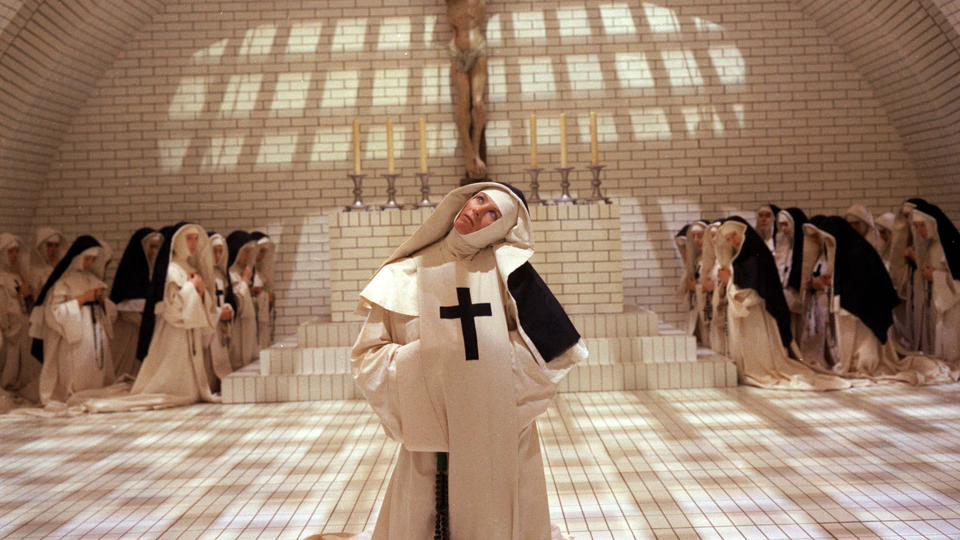
Ken Russell’s The Devils opens with a title card assuring us that its principal characters really lived and its major events really happened. The next thing we see is King Louis XIII of France dressed as Venus and rising from a clamshell while his court applauds with the enthusiasm of people who know what happens to those who don’t. The title card is more or less honest. There was a priest named Urbain Grandier, there was a abbess named Sister Jeanne who swore he had sent devils into her convent, and he was burned alive in Loudun. On those facts Russell builds a transcendent indictment of power and a cautionary tale about what becomes of people who want something too much or forbid themselves to want anything at all.
The time is the 1630s. Cardinal Richelieu, eager to break the provincial nobles after the Huguenot uprisings, persuades the king to tear down the walls of every fortified town in France. Louis exempts Loudun because of a promise he made to its late governor. Richelieu sends his agent, the Baron de Laubardemont, anyway, and the baron runs into Grandier, the parish priest, who is loved by Catholics and Protestants alike and by a fair number of their wives and daughters. Laubardemont recruits a jealous fellow priest and a town merchant with a grudge of his own. Then he finds an ally he could not have planned for, inside the Ursuline convent.
Oliver Reed plays Grandier with long hair and a waxed mustache, and he moves through Loudun like a rock star on a tour that has gone on a few weeks too long. He has fathered a child with one young woman and abandoned her, and he is about to marry another in secret, a sacrament the Church has not made available to its priests. Vanessa Redgrave’s Sister Jeanne is his opposite. She is hunchbacked and severe, and she runs her convent by punishing her nuns for the sins she commits nightly in her imagination. She has never met Grandier. That doesn’t stop her from fantasizing about him in the role of Christ, and when he declines to become the convent’s confessor, she accuses him of bewitching her.
Laubardemont sends for an inquisitor to handle the case. Russell’s solution to one rock star is to bring in a second. Michael Gothard’s Father Barre arrives with his own long hair and a pair of tinted round glasses that suggest John Lennon on his way to a press conference. Gothard manages the near-impossible feat of holding the screen opposite Reed. To help, Russell gradually tones Reed down and amps Gothard up as the power in Loudun changes hands. Barre’s exorcisms work the nuns into a frenzy, and here we reach the scene Warner Bros. removed before release, in which the convent becomes an orgy and the nuns pull down a statue of Christ and defile it. The film has been restored to include it. The scene is as shocking as its reputation, and it belongs in the movie, because without it we see Barre’s spectacle only from the outside.
The production design is by Derek Jarman, who had never designed a film before and built the whole town at Pinewood without much regard for what 17th-century France looked like. His Loudun is all towering white walls, closer to Metropolis than to any history book. The convent is lined with white tile, like a bathroom or an operating theater, a place that looks as if it should be hosed down after use. In one scene the conspirators lean in together while Russell shoots them from below, and you could drop that shot into Terry Gilliam’s Brazil without anyone noticing the seam. Gilliam’s film shares this one’s interest in a bureaucracy that has learned to make murder look like paperwork.
Reed begins as a charming monster and ends as a martyr, and the third act holds some of the best work he ever did. Shaved, broken by torture (the makeup effects are grimly convincing), he finds in his suffering the faith he only practiced when things were easy. If you know Reed mainly from stories about his talk-show appearances and his drinking, watch his work here. It explains why people put up with the rest. Redgrave disappears into Sister Jeanne without becoming any less magnetic. It is a strange accomplishment to fill a film with people this reprehensible and keep us unable to look away from any of them, especially with an ending that offers no consolation.
My reservation is the pacing. At just under two hours, the film feels like a cut that was never trimmed after its test screenings. I wouldn’t remove a scene, but I’d tighten most of them. Before the convent orgy, Grandier, on his way home from a meeting with the king, stops alone in the countryside and prepares communion for himself. Russell then cuts back to those same shots during the orgy, to set Grandier’s simple devotion against the convent’s hypocrisy. The idea is right, but having just seen those shots, we feel the repetition more than the contrast. Maybe it’s a leftover from restoring the censored footage. The same looseness turns up elsewhere, in good scenes that run a little past the point where they’ve made it.
Russell died in 2011, before the film he made was widely seen in the form he made it. The new restoration makes his vision available to generations for whom it had been mostly a rumor. Those who come expecting an attack on religion will be surprised. Russell was a Catholic convert, and his film never blames the faith for what happens in Loudun. It blames the men in Paris who want power and the people in Loudun happy to help them get it. Grandier is the only person in the story who takes God seriously, and the film takes him seriously in return. Believers and atheists can walk out of this one in agreement.