The Curse of the Mummy's Tomb

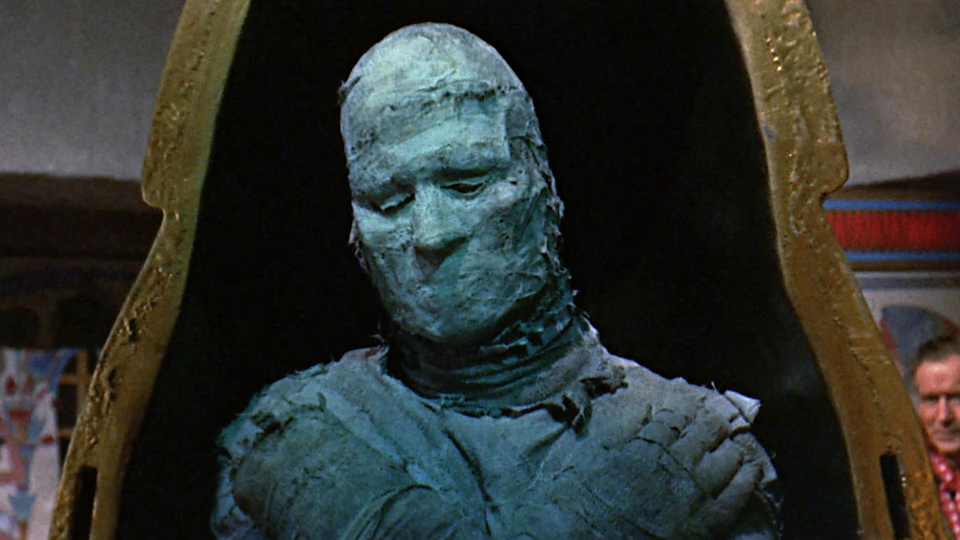
You know the drill. Archeologists dig up a mummy. The mummy wakes up. People die. Credits roll.
Michael Carreras—son of Hammer co-founder James Carreras, here writing, directing, and producing—tries to freshen the formula with a backstory: our mummy is Ra-Antef, a prince murdered by his treacherous brother.
We see this in flashback. We also see a crowd of Hammer extras, bronzed and kohl-rimmed into approximations of ancient Egyptians, bowing before Ra-Antef himself—who is inexplicably, almost defiantly, Anglo-European and unpainted. The tomb paintings that bracket the sequence, meanwhile, depict Egyptians who actually look Egyptian. Carreras put the contradiction on screen himself. It takes a special kind of obliviousness to contradict your own production design and then build your third-act twist on top of it.
Fred Clark steals the picture as an American showman—part P.T. Barnum, part backroom operator—a man who thinks nothing of ending a colleague’s career out of spite, but shows enough concern to slip a passing streetwalker money for a warm meal and a room for the night. Ronald Howard and Jack Gwillim are solid as the requisite British academics, making the most of stereotypical roles.
Top-billed Terence Morgan, however, delivers every line as though he has somewhere better to be. His love interest, Jeanne Roland—improbably cast as an archeologist—is equally inert. Their eventual kiss is less romantic than clinical: he doesn’t so much kiss her as rub his mouth on her face. One suspects they did not carpool.
The mummy himself—and this is the film’s cardinal sin—does not appear until thirty minutes in. He does not do anything for another twenty after that. The mystery filling that gap is telegraphed early and collapses under the lightest scrutiny. The picture is killing time until it has to be a monster movie.
When it finally gets there, one scene earns its keep. Foggy London waterfront. Distant ships. A hulking figure stepping from the dark, wheezing like a bellows in a haunted house. It is atmospheric and genuinely unsettling. It is also about ninety seconds. Then the film remembers itself and returns to its habits.
At 81 minutes, at least it has the decency not to overstay its welcome. And the Elstree studio sets make a pleasant change from Hammer’s usual Bray locations. Small mercies.
The Curse of the Mummy’s Tomb is for Hammer completists only. Everyone else has already seen a better version of this movie.