The Brotherhood of Satan

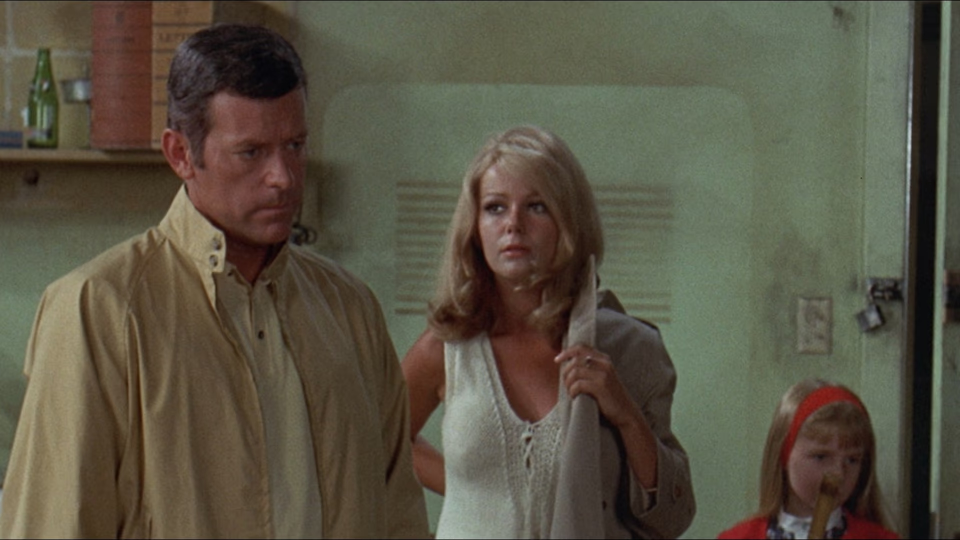
A man, his daughter, and his girlfriend stumble into the small southwestern town of Hillsboro and find the locals hostile, roads impassable, children vanishing. Nobody gets in. Nobody gets out. Except them—and there’s a reason for that.
The reason involves a coven of elderly Satanists performing a ritual to transfer their souls into the bodies of abducted children. They’ve done it before. They’ll do it again, in fifty or sixty years, in some other unlucky town. That’s genuinely dark—not cynical, but nihilistic in a way the film earns without quite knowing it’s earning it.
The Brotherhood of Satan arrived in the long shadow of Rosemary’s Baby, and it tries for Polanski’s trick: inventive camerawork, operatic performances, the sense that something ancient and patient is waiting just offscreen. It lands said trick about half the time.
Director Bernard McEveety has some ideas. The production design makes excellent use of flat desert geography, the kind of landscape where help feels not just far away but cosmically unavailable. The witches kill with methods that involve children’s toys—a detail the film wisely never explains.
Then McEveety has other ideas. Early on we get a lot of footage of Ben and company winding through the lonely southwest roads before arriving in Hillsboro. You know the shot: driver in profile, passengers behind, deep focus. Except McEveety positions the camera in extreme close-up such that Ben’s jaw fills a quarter of the screen. This suggests an anxiety disconnected from the narrative. Better to save this shot for their initial escape attempt, when the claustrophobic framing could have contrasted their earlier lackadaisical cruising. Instead, it reads as either a technical gaffe or stylistic pretension.
The script missteps as well. A key reveal lands too early. After that, a certain character teleports from scene to scene, seemingly between vigorous hair appointments. The script’s ellipses—and there are good ones—start to look less like restraint and more like oversight.
The finale abandons the desert for a soundstage with walls meant to look like stone and a giant fake cobweb. Given that the actual locations were doing the heavy lifting for free, this is a puzzling trade.
That said, I appreciated the film’s subversive commitment. The local priest, the man who in any other movie would lead the charge against evil, goes to pieces at his first sight of violence. And the witches are brutal. Not a colorful group of small-town eccentrics who fell in with the wrong crowd, but an ancient cabal of ruthless predators gleeful at the idea of essentially murdering children. Its bleakness borders on black-comedy.
Still, McEveety and his writers came up short. Zach Cregger’s Weapons, however, covers similar ground—small town, missing children, a few other elements I’ll leave alone—and does it better. It’s not a remake. More like the same ingredients in a better kitchen. Cregger’s finale even mirrors a scene here, just improved.
Fans of Weapons needn’t sprint to find this one, they’ve seen the better movie. But if you have a weakness for 70s Satanic shockers and can forgive a film for being almost good, The Brotherhood of Satan offers enough genuine unease to justify a watch.