The Brink's Job

William Friedkin squanders a great heist on cheap laughs that never land.
The Brink’s Job tells the story of the 1950 Brink’s warehouse robbery in Boston—history’s then-biggest score, pulled off by neighborhood goons who couldn’t rob a candy store. Literally. They try that first, and it’s where the trouble begins.
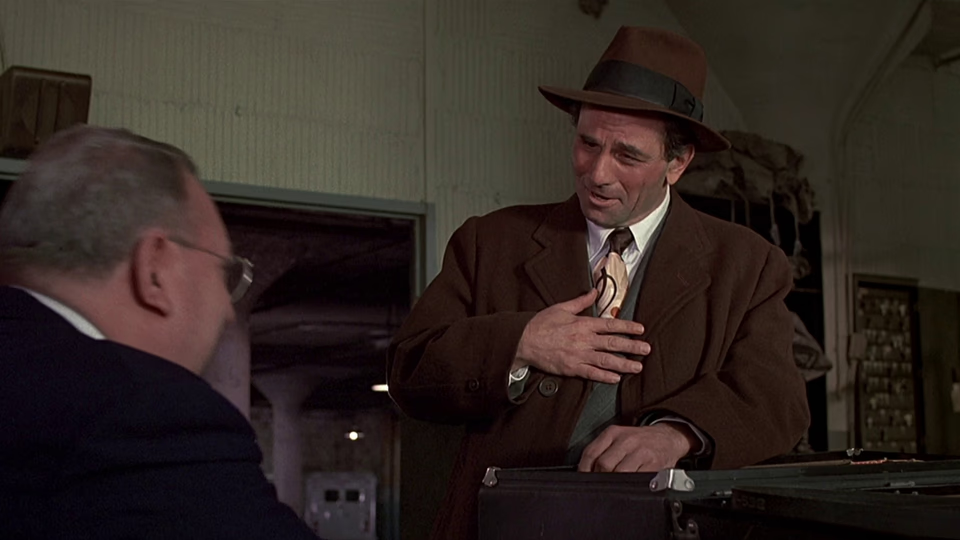
Peter Falk plays the ringleader of this bumbling crew. Peter Boyle shows up as a fence, Paul Sorvino as a bookie, Allen Garfield as Falk’s hopeless brother-in-law, and Warren Oates as an unstable demolitions man. The talent is there. The movie isn’t.
Friedkin and screenwriter Walon Green modeled their film after Big Deal on Madonna Street,1 an Italian caper comedy about incompetent thieves. But something got lost in translation—mainly the laughs. This kind of comedy needs charm, wit, a light touch. Instead we get gags imported from Saturday morning cartoons. During that candy factory heist, Garfield eyes a door with “BALL ROOM” and “DO NOT OPEN THIS DOOR” stenciled in large type. Of course, he opens it and gets buried in gumballs. Falk steps in bins of sugar and flails around like a vaudeville performer. These bits were stale when Chaplin did them better fifty years prior.
Green, who wrote The Wild Bunch, should have known better. There’s a scene where Falk breaks into the Brink’s garage and narrates his thoughts via voice-over. Then he starts talking aloud to himself. Then he starts reading the newspaper aloud. It’s a slow-motion train wreck of screenwriting choices, each one worse than the last.
Falk himself is badly miscast. He’s not hard enough to play a genuine hood, not charming enough to make us root for a lovable rogue. He seems caught between playing Columbo and delivering something Friedkin wants but can’t quite extract from him. The performance never finds its footing.
Warren Oates, though, is terrific. He joins the gang late as a fast-talking war veteran, and he’s the one who eventually cracks under pressure and sends everyone to prison. He gets the film’s single best line. Stopping in a small town on the way to Pittsburgh, his companion remarks, “It’s a lovely town.” Oates deadpans: “Ain’t it? I spent a week here, one night.” That’s sharp writing. Compare it to the clunky tough-guy dialogue elsewhere: “You wanna blast that pete with a cannon? You gotta have a hole in your marble bag.”
The waste here is criminal. This story—local crew pulls off an impossible score—sits at the heart of great crime films. Scorsese would later show how it’s done in Goodfellas: take it seriously, focus on the people, not just the caper. Friedkin had the location photography, the period detail, the budget, and the extras. He’d already proven with The French Connection that he could create an immersive crime picture. Maybe that’s why he went for comedy—a reluctance to retread the same ground.
Whatever the reason, it backfired. Friedkin himself later admitted: “The Brink’s Job has some nice moments, despite thinly drawn characters, but it left no footprint. There’s little intensity or suspense, and the humor is an acquired taste. The film doesn’t shout, it doesn’t sing—it barely whispers.”2
He’s being generous.