The 14 Amazons

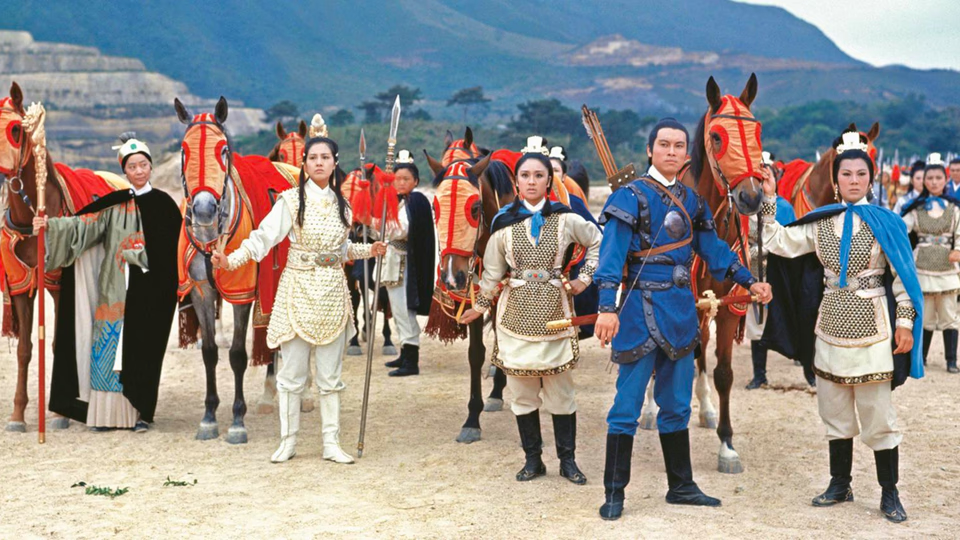
The 14 Amazons is a Shaw Brothers picture at war with itself. It opens with a scale unusual for the cost-conscious studio, stumbles into melodrama and baffling casting, then claws its way back with sheer spectacle. It does this several times. The movie doesn’t so much build momentum as lurch between ambition and miscalculation.
The story is set during the Song Dynasty. The Yang family has supplied generals to the empire for generations. When their last male commander falls in battle against the Western Xia, his widow and daughters-in-law decide to avenge him. A corrupt bureaucrat blocks access to the imperial army, so the women raise a volunteer force and march out themselves. It’s a terrific premise.
That opening battle is something. We’re outdoors, under real skies, with cloud-tipped mountains in the background and scores of extras bleeding across a genuine landscape. Bodies are dragged through the sand leaving red streaks. In ten minutes we’ve seen more production value than most Shaw Brothers films manage in ninety. You sit up in your seat.
But amidst the spectacle, every time a new cast member appears on screen, the image freezes and their name and role flash up. This is a large cast. We get generals, princes (first, second, third, and fourth), and then the Yang women (first auntie, second auntie, and so on through fourteen). It takes thirteen minutes. What begins as an introduction becomes an endurance test. I began to wonder if there was a fifteenth amazon they’d cut for time.
And then the melodrama. Weepy violins swell to announce the general’s death, as though the bloody battlefield and the grieving widow weren’t enough. The score doesn’t trust us to feel. It hammers the point home.
Then there is the general’s son, who I think is meant to be a teenager. I say “think” because the other characters refer to the character as a child, but the role is played by a woman in her late twenties. I waited for some revelation. None came. The performance is all huffing and pouting and theatrical petulance. There must be some cultural context I’m missing. Imagine a Rat Pack picture where Peter Lawford plays a college co-ed and Frank, Dean, and Sammy never mention it.
And yet the film overcomes. The production values hold. Horses, wagons, outdoor locations. Hua Yueh turns up as a slave who joins the Yang cause, and brings real physicality to his fights. The choreography throughout is strong, sometimes excellent.
But a pattern nags. In the crucial fights, characters who should lose make inexplicable comebacks. Hua Yueh battles the Xia boxing champion, played by Bolo Yeung, who will be familiar to fans of Bloodsport. Bolo dominates. He’s faster, stronger, better armed. With Hua Yueh on the ground, beaten, Bolo kicks him off a ledge. Hua Yueh does a full-story belly flop to the stone floor below. Bolo drops down for the kill. Hua Yueh catches his feet, trips him, and somehow wins the fight. The movie cheats like this repeatedly. Characters don’t win as much as the script abruptly forces others to lose.
There is also the matter of Hua Yueh’s escape. He’s been enslaved by the Xia for years, his village conquered. Yet, when the plot requires it, he flees the Xia camp to join the Yang army with no difficulty. One wonders what he was waiting for.
Still. There is a sequence involving a canyon and a rope bridge that makes the film. The bridge is sabotaged. The army is split, half on each side. The Xia are closing in. What the Yangs do next involves a human pyramid and must be seen to be believed. You can spot the seams in the effect, but it doesn’t matter. It is a triumph of editing and stunt work, the kind of sequence where even if you don’t care about the characters, you care about the stunt.
And that’s the film’s deepest flaw. The female leads are too numerous and too interchangeable. Worse, they are inconsistent. In battle they parry halberds wielded by men twice their size. Between battles they struggle with bags of rice and dissolve into tears. They are badasses and stereotypes, sometimes in the same scene. The movie wants to celebrate them but can’t quite commit.
What saves it, finally, is the spectacle. The climactic battle is ferocious and chaotic. Scores of extras. Swords clash against shields. Spears pierce flesh. Bodies are sliced and bloody torsos hit the sand. The camera weaves through the melee and finds Ivy Ling Po, the Yang field general, turning with her spear raised, dust swirling around her, scanning for her opposite number. Total badass. Everything the movie wanted to be, captured in a single shot.
If the film’s reach exceeds its grasp at times, it can be forgiven. A sluice gate no taller than the characters who breach it somehow triggers a flood that wipes out an army. The budget, large for Shaw Brothers, still couldn’t accommodate every ambition. But the heart was there. For fans of Shaw Brothers or wuxia cinema, The 14 Amazons offers enough glimpses of the great film it almost was to make it worth a watch.