Source Code

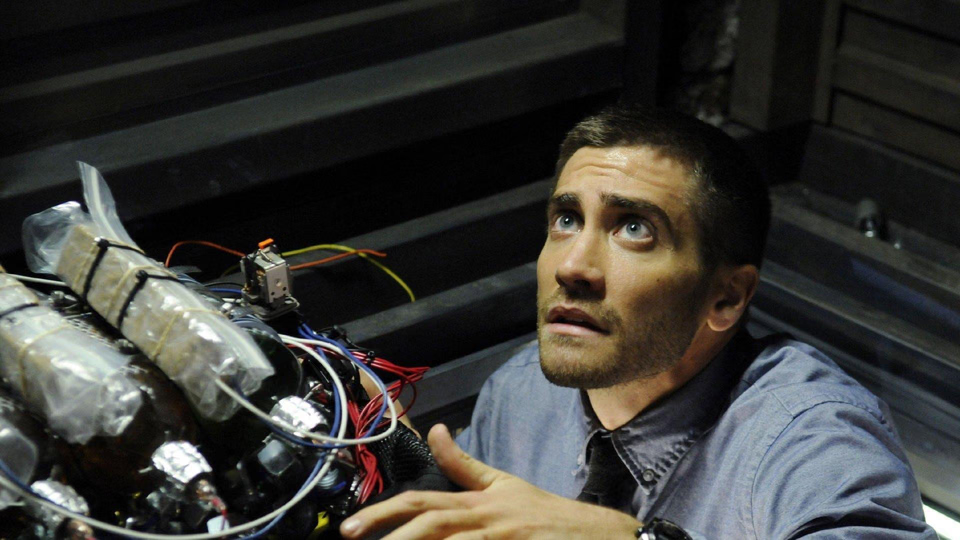
Jake Gyllenhaal wakes up on a Metra train into Chicago with no idea how he got there. Michelle Monaghan sits across from him, calling him Sean and picking up the middle of a conversation he has never had. Coffee spills. A conductor wants a ticket he doesn’t have. He catches his reflection in the window and it belongs to a stranger. Eight minutes later the train explodes and takes him with it.
Then he’s strapped into a dim metal pod that looks scavenged from a decommissioned flight simulator. On a monitor, Air Force captain Vera Farmiga tells him the train is already gone. It blew up this morning. Everyone died, including the man whose eyes he was borrowing. What he visited was a reconstruction stitched from that man’s last memories, and somewhere inside those eight minutes is the bomber, who has a much larger device pointed at downtown by dinnertime. So back he goes. Dies. Returns. Dies again.
Gyllenhaal is the reason any of this holds. He plays a decent, badly overmatched soldier doing long division underwater, and he manufactures more charisma than the screenplay ever loans him. Monaghan has the harder job, playing the same eight minutes a dozen times while pretending each is her first, and she keeps finding new small human things to do with them. She’s warm in a movie with a temperature problem.
Farmiga and Jeffrey Wright get the roles with actual conflict written into them, which in this case means they’re thin instead of transparent. Wright plays the scientist with a limp and a god complex. He is having a wonderful time.
Duncan Jones, who made Moon for approximately the catering budget of a Michael Bay picture, again does a great deal with very little. He keeps a train car from feeling like a train car, which is a real trick, and he moves the thing along at a clip that discourages arithmetic.
The screenplay is where things buckle. Ben Ripley says in the commentary that he set out to make a time-loop picture with a new hook. He came up with Quantum Leap crossed with Groundhog Day. Fine. Films have been built on worse. But then Wright starts explaining the machinery, something involving light bulbs and residual traces in the brain, and the movie wants us to accept it as science while using it as magic whenever the plot needs a favor.
I have no objection to this sort of sci-fi nonsense. Face/Off survived its own suspect science because John Woo had the good manners not to care. This movie cares. It wants a discussion about what the military owes the dead. The moment you open that door, you have to deal with the question sitting in the second row with its hand up: whose body is that? His name was Sean Fentress. He taught school. He had a Tuesday planned.
The structure grates too. We’re meant to share Gyllenhaal’s confusion, but he’s confused because nobody will answer him, and nobody will answer him because a straight answer at minute ten would end the movie at minute thirty. Two honest minutes of exposition and this man solves his case before lunch. That’s padding in a lab coat.
None of which makes Source Code a bad picture. It’s watchable, brisk, occasionally moving, and acted well above its station. It still lands a hair shy of satisfying. Three years later Tom Cruise and Emily Blunt ran nearly the same live-die-repeat premise in Edge of Tomorrow, minus the Quantum Leap body swap. Watch that instead.