Sahara

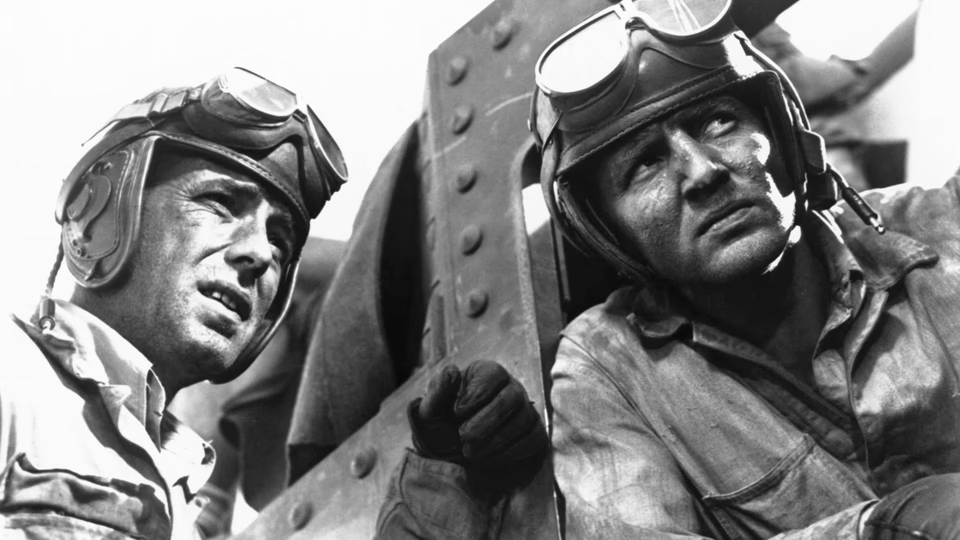
Zoltan Korda’s Sahara opens the way a good war picture should: in the middle of things. Shells are falling. The order to retreat is crackling over the radio. And Humphrey Bogart is trying to fix a tank. No preamble, no sentiment. Just war.
The setup is lean. Bogart plays Sergeant Joe Gunn, an American tank commander who picks up a ragtag collection of Allied stragglers during a retreat across North Africa. They find a well. It has a little water. A German battalion needs it. The rest follows.
Bogart was on loan from Warner Bros. at the peak of his powers. Casablanca was just the year before. He plays a committed army man, no family, no cynicism to hide behind, nothing but his men, his tank, and the war. On paper it’s thin. But Bogart finds something in the marrow of it. A weariness. A gravity. He convinces you he has been in this desert a long time before the cameras started rolling.
You might expect Bogart to swallow a picture like this whole, but he doesn’t. Sahara plays like an ensemble, and the ensemble delivers. I especially liked “Frenchie,” who explains his loyalty to Bogart with the most honest line in the picture: “I like your cigarettes.” And Rex Ingram, as a Sudanese soldier, gets the film’s most rousing moment when he makes a Nazi eat sand. I can imagine 1943 audiences cheering.
Not everything works. Kurt Kreuger plays a downed German pilot taken prisoner. Blonde, sneering, contemptuous: he is a cardboard Nazi, assembled from the standard-issue parts. Kreuger plays him well enough, but he’s a symbol, not a man. The third act leans into this, with speeches aimed less at the other characters than at the wartime audience sitting in the dark. These bits likely resonated in 1943 but feel clunky now.
That said, the production values hold up. Korda shot in the California desert near the Salton Sea, using real tanks, and the result is immersive. The blinding sandstorms and the grit covering every face have authenticity. The assault sequences, packed with extras, have scale. Only the flies betray the illusion. In the middle of the Sahara, nothing lives, and certainly not that many flies. It’s a small thing. But it breaks the spell, briefly, every time.
Like Bogart’s other 1943 war picture, Action in the North Atlantic, Sahara has never quite gotten the credit it deserves. It is not a great movie. But it is a solid one, efficiently constructed, unpretentiously performed, occasionally rousing. Bogart fans will find plenty. So will anyone who wants to understand what American cinema was doing when the war was still very much in doubt.