Robot Jox

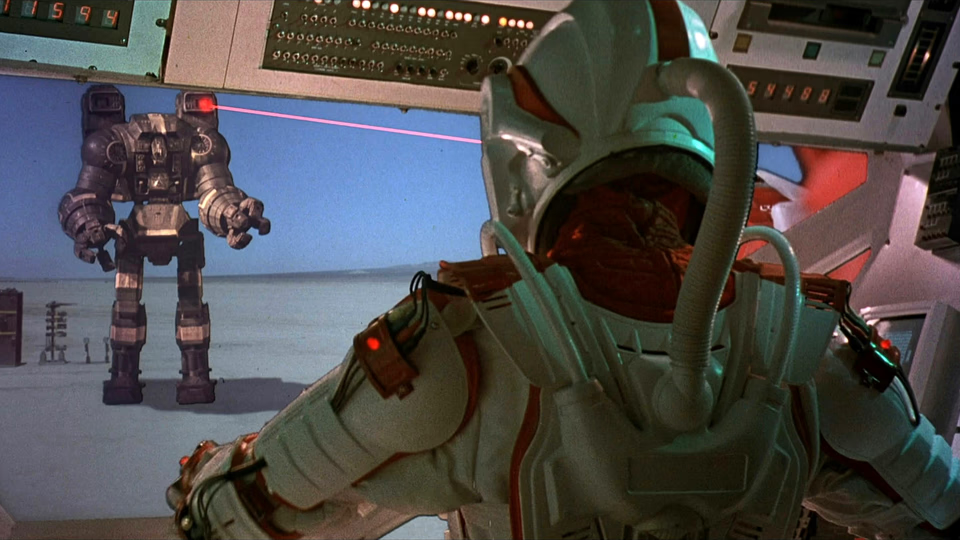
It’s fifty years after the last nuclear war nobody won. Traditional warfare has been outlawed. Now two superpowers—the American-esque Market and the Soviet-esque Confederation—settle their disputes the old-fashioned way: giant robots, one-on-one, while spectators watch from the stands. It is, if nothing else, an improvement on what came before.
The setup borrows loosely from Homer. We open with Achilles, the Market’s champion, facing Alexander, the Confederation’s star. When Alexander pulls a dirty trick that kills a crowd of bystanders, the governing body calls it a draw. Achilles quits in disgust. In steps Athena—genetically engineered, fearless, empty of empathy—who steals Achilles’ robot and proceeds to demonstrate why empathy exists in the first place. Achilles, moved by something she lacks the wiring to feel, climbs back in.
I went in expecting very little. I came out surprised.
The film feels like a well-made episode of 1980s science-fiction television. Think Buck Rogers, or the original Battlestar Galactica. That is not an insult. Those shows had a certain confidence about their own limitations. Robot Jox has that same confidence. Its animatronic robots, in their best moments, actually look like robots: heavy, battered, slow in the way that something enormous would be slow. The stop-motion sequences look like cartoons. You roll with it.
Stuart Gordon directed Re-Animator and From Beyond. He knows how to build a world from the ground up. Here the world has hover cars and mandatory breathing masks and people stacked into concrete megastructures on a scorched earth. It’s a shabby, lived-in future—the kind that convinces because it’s not fancy or overproduced. The atmosphere is doing real work. It makes the robots all the more extraordinary.
At 85 minutes, the film has enough story to justify the robots and not one scene more. Yes, Athena gets discarded. Yes, the questions about genetic engineering and gladiatorial proxy warfare go largely unexplored. These are choices. The film knows what it is. Respecting that is not the same as lowering your standards.
Gary Graham plays Achilles the way John Wayne played cowboys in his lean years: committed, a little strutting, never fooled about his place in the picture. Despite getting top billing, he knows he’s not the star. A working man playing a working man.
The film was shot in 1987. Empire Pictures folded before it could be released. It sat on a shelf for three years, then appeared on video and cable, where it found its audience—or rather, its audience found it. I was fourteen in 1990 and thought it looked too childish. Had it arrived on schedule in ’87, I’d have worn out the tape.
The target audience is specific: anyone who grew up on Transformers, Voltron, Robotech. Anyone who remembers when the Wall was still standing and the Cold War was a permanent condition of existence. For those people, watching a giant American robot fight a giant Soviet robot will feel like recovering a lost memory. For everyone else, the seams will show.
But you already know which camp you’re in. The idea either does something for you or it doesn’t. I can’t help you with that part.