Pump Up the Volume

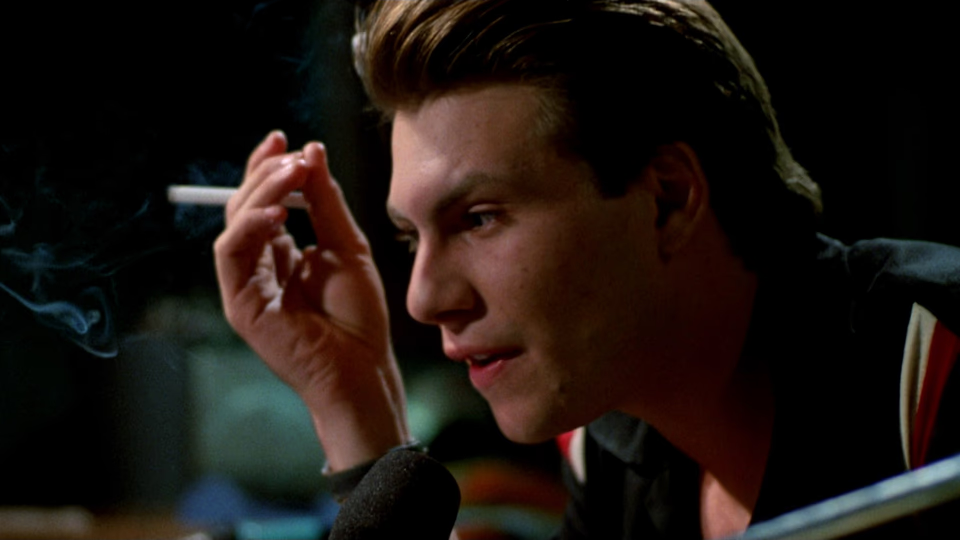
There is a moment near the end of Pump Up the Volume when Christian Slater removes his glasses and looks out over a crowd of kids who have gathered because of him, because of what he said into a cheap microphone in his basement. The camera shifts to slow motion, then to his point of view, then back again as a grin spreads across his face. His two selves have finally merged. It is an audacious piece of filmmaking, and it works because writer-director Allan Moyle has been saving his visual fireworks for exactly this moment.
Slater plays Mark Hunter, a teenager dragged from the East Coast to one of those Arizona suburbs that look like they were designed by someone who hates surprises. He is paralyzed by shyness. He cannot speak to his classmates. But every night he fires up a shortwave transmitter and becomes Hard Harry, a profane, funny, reckless pirate DJ who says everything his daytime self cannot. The kids start listening. Then they start caring. Then things get complicated.
I should confess something. I was entering high school when this film came out, and it hit me the way The Breakfast Club hit the class ahead of me. Watching it for the first time in twenty-some years, I was startled at how young Slater looks. He was always older than me before. But by the end I was caught up in it all over again—the music, the anger, the ridiculous hope of it all. How much of that is the movie and how much is muscle memory, I cannot honestly say. But I will try.
Slater is very good here. This is essentially a dual role, and he navigates both halves with deceptive ease. Yes, he was openly aping Jack Nicholson but he apes him brilliantly. Nicholson himself wasn’t this interesting at twenty. The script is wall-to-wall talk, which is a danger for any young actor, but Slater sells the angst without tipping into self-pity. You believe both the kid who can’t say hi to a girl and the kid who tells a few thousand listeners that everything in America is completely screwed up.
The screenplay is the engine. Moyle writes a high school world that is reductive and idealized, and I mean both of those as compliments. Where John Hughes dissected the caste system of jocks, nerds, and princesses, Moyle imagines something different: a school where music pulls the tribes together instead of sorting them, where the enemy is a corrupt administration rather than each other, where parents actually show up and do the right thing. It is escapism, but it’s smart escapism. It allows Moyle to talk to teens as a whole, with dialogue frank enough to earn the film’s edge.
When Slater tells his audience that high school is the bottom, that being a teenager is miserable—that surviving it is the whole point—it still lands. There is an honest clarity to the speech that no amount of irony can dull. Quitting is not strength. Living is. Try telling a fifteen-year-old that the years everyone calls the best of their life are actually just something to get through. They will listen, if you say it right.
What strikes me now is how precisely Moyle anticipated something. His pirate radio is social media before social media existed—kids finding their voices, speaking as themselves, building a community from nothing. The difference is that Moyle’s version is optimistic. The airwaves fill with kids finding something real to say rather than competing for attention or hawking their latest hustle. For a film built on cynicism, it is remarkably hopeful about what happens when young people are simply heard.
Moyle the director matches Moyle the writer. He has a sharp eye for suburban emptiness—the tract housing, the strip malls, the freeways that connect nothing to nothing. The opening shot pans across this landscape like a slow accusation. And the finale, which on paper involves a car chase and a helicopter and should be ridiculous, builds with a momentum that feels earned to a conclusion that feels inevitable.
Then there is the soundtrack, which deserves its own paragraph because it changed lives. No pop. Leonard Cohen, the Pixies, Soundgarden, Ice-T, Concrete Blonde. In 1990 these were not MTV bands. You might catch them on a college station if you were lucky. For a generation of kids in small towns, the movie was like a mix tape from a cooler friend you hadn’t met yet.
Pump Up the Volume is not a perfect film. It oversimplifies. It romanticizes. Its villains are one-dimensional. I do not care. It has something more valuable than perfection: it has nerve, and a beating heart, and a closing line that still makes me grin like an idiot. I suspect the craft is real. Good movies don’t just trigger nostalgia. They survive it.