Nobody

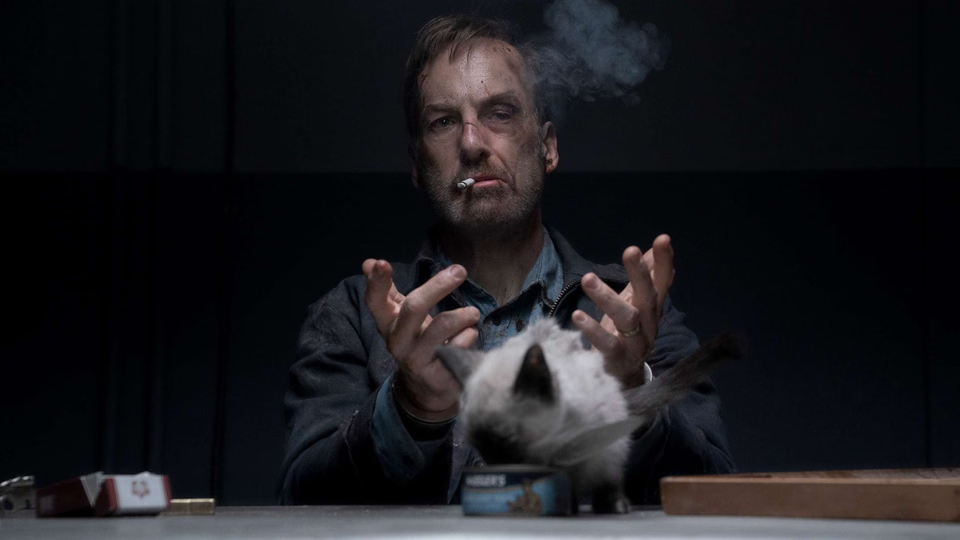
Every week Hutch Mansell runs down his driveway in his pajamas, dragging a garbage bin, and every week the truck pulls away without him. His wife sleeps behind a wall of pillows. His teenage son looks at him the way you look at a thermostat. When burglars break in one night, Hutch has a golf club raised over one of them and lets him go, and the son decides his father is a coward. The neighbors and cops agree, though not in so many words.
Bob Odenkirk plays Hutch, and if you know him as Saul Goodman you will spend the opening scenes waiting for him to talk his way out of something. He hardly talks at all. He keeps the books at his father-in-law’s machine shop and accepts abuse from a brother-in-law who can’t believe his sister settled for such a putz. Odenkirk has a face built for absorbing insults, which is why what comes next works.
Hutch’s little daughter can’t find her kitty-cat bracelet. He decides the burglars took it, puts on his jacket, and walks out of the house. A few scenes later Odenkirk is aiming a pistol and demanding “the goddamn kitty-cat bracelet!” The movie knows exactly how absurd that is and plays it with a straight face, and I laughed harder than I have at most comedies this year.
Hutch, it turns out, used to be an “auditor” for government agencies that go by initials. The title means he was the last person you wanted to see. The plot turns on a late-night bus ride. A gang of drunk Russians boards and menaces a young woman. Hutch shoos the driver off, then fights them. He is rusty. He gets hit, badly and often, and seems happier than he has been in fifteen years. The fight ends with him performing a tracheotomy on one of his assailants with a drinking straw, a courtesy I have not seen extended in many action pictures. Unfortunately, one of the thugs has a well-connected brother, and soon the Russian mob is interested in Hutch’s suburban split-level.
The screenplay is by Derek Kolstad, who wrote John Wick, in which the death of a puppy justified the thinning of a large portion of the Russian underworld. Like that film, this one has no interest in the ethics of vigilantism. John Wick was already a killer when we met him. Hutch is a suburban dad who can’t get the garbage out on time, and Odenkirk makes him the most persuasive unlikely hero since Bruce Willis crawled through the air ducts in Die Hard. Odenkirk has said the idea came partly from a real break-in at his own home, when he did nothing and felt small afterward. You can see that feeling in the early scenes. It gives the fantasy something to push against.
The director, Ilya Naishuller, has said he imagined Hutch as an antihero out of a Korean revenge picture like Oldboy. With respect, he has made a different movie than he thinks. The hero of Oldboy is a ruin. Hutch is the neighbor you would lend your ladder to. Kolstad seems to have understood this, or he wouldn’t have hung the whole plot on a child’s bracelet.
The best scene arrives when the Russians come to the house. Hutch hustles his family into the basement, and as the steel door closes, he tells his wife, calmly but firmly, “Don’t call 911.” I whooped. It is the adrenaline rush that action fans chase and seldom catch.
After that, the movie turns into the movie it was imitating. Hutch rigs the machine shop with enough traps to make it Home Alone with claymores. Christopher Lloyd, as Hutch’s father, whom we first meet dozing in front of westerns at a retirement home, shows up with an arsenal. “You brought a lot of shotguns,” Hutch says. “You brought a lot of Russians,” Lloyd replies. RZA turns up too, as Hutch’s brother, and seems to be having a fine time.
All of this is fun, and fans of the Wick pictures will get what they came for. But the transformation was the story, and once Hutch is fully transformed, there is nowhere left to go but more bullets. The last half hour is a good action movie. The first hour is something better.