Hard Boiled

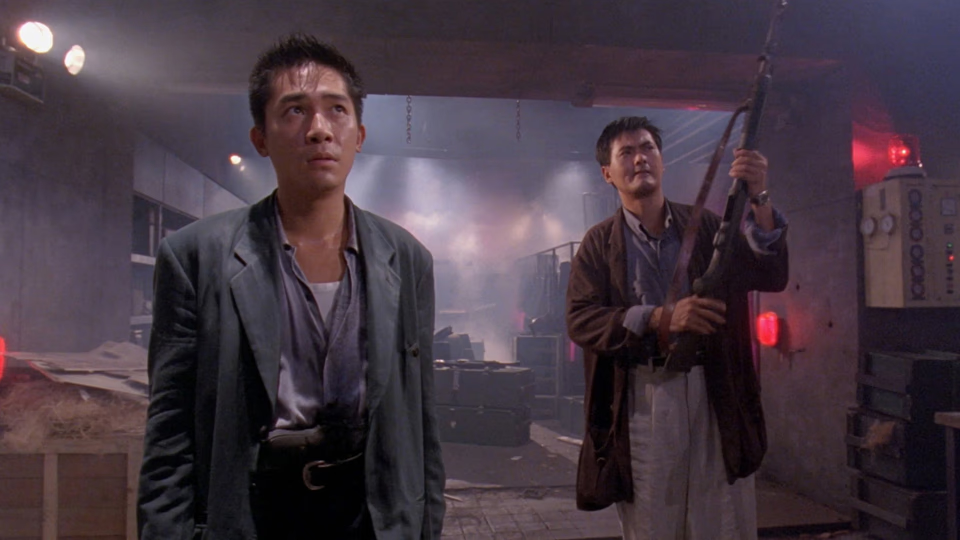
There is a moment in Hard Boiled when Chow Yun-Fat skeet-shoots a motorcycle out of the air. The rider has launched himself like a guided missile. Chow, wielding a shotgun, hits the gas tank. The bike explodes in a fireball and crashes behind him. He doesn’t look back. Of course he doesn’t.
In a lesser film, you’d roll your eyes, but John Woo’s 1992 Hong Kong action picture earns its excess. Set in a world of arms dealers, undercover cops, and men who solve problems with large-caliber firearms, its plot is dense but inevitable. Chow plays Tequila, an obsessive inspector trying to dismantle a gun-running syndicate. His methods are effective but his superior hates them. He doesn’t bring in witnesses. He brings in bodies.
On the other side of the law—barely—is Alan, played by Tony Leung Chiu-wai, an assassin working for one triad boss while being courted by another. The courting boss is Johnny Wong, played by Anthony Wong with the cheerful menace of a man without a conscience. Alan takes Wong’s offer, helps him raid his old boss’s arsenal, and sets a trap. Tequila, tipped off through his own channels, crashes the party. Bullets fly.
Lots of bullets.
That the film works beyond its gunfights is a credit to its three leads. Chow Yun-Fat is movie-star charismatic in the way of Clint Eastwood and Steve McQueen, but warmer. Anthony Wong makes villainy look like a reasonable career choice. But the surprise is Leung Chiu-wai. His Alan is a man being crushed between two millstones, and Leung underplays it beautifully—a Hawksian professional—no speeches, no tears. He simply does his job and lets the anguish leak through the cracks. Where Chow and Wong play the extremes, Leung plays the middle, and the film is smarter for it.
Woo gives each of them room to breathe between the carnage. Tequila plays jazz clarinet in a bar. Alan folds paper cranes. Wong rationalizes murder with the silky logic of a man selling insurance. These details cost nothing and buy everything.
Then the shooting starts again.
Woo stages the action with the choreographed grace of the kung-fu films he cut his teeth on. His shootouts are not realistic. They are better than realistic. Characters dive through doorways in slow motion. Debris swirls like confetti. Early on, Chow dual-wields pistols, taking out men on opposite sides of the room simultaneously, and the camera loves every second of it. Then he acquires the shotgun, which blows holes in walls, sends bad guys flying backwards as though fired from a cannon, and turns ordinary barrels into spectacular explosions. It deserves its own screen credit.
The film owes a debt to Michael Mann’s Miami Vice and more than a passing nod to William Friedkin’s To Live and Die in L.A. But where Friedkin was reaching for something beyond The French Connection and not quite grasping it, Woo grabs it with both hands. Friedkin’s original film had a documentary grit that gave it power. Woo isn’t interested in grit. He’s interested in opera.
The stakes escalate with gleeful precision. An opening teahouse shootout is bloody and blunt. A warehouse raid is bigger. By the final act, the showdown has moved to a hospital rigged with explosives, and cops are lowering bassinets full of newborns out of upper-story windows while gunmen try to shoot them. Chow cradles a baby in one arm and fires with the other. It is completely bonkers. It works because the film has been teaching you its language from the first frame, ratcheting up the style until you accept things you’d laugh at in lesser hands.
I am told this film cost less than five million dollars. If you had told me a hundred million, I would have believed you. There is no computer animation. The stunts are real, and they look real—frantic, dangerous, and thrilling in the way that a stuntman risking his neck will always be more thrilling than a pixel risking nothing. Hong Kong location photography gives the film a texture no soundstage could replicate.
Something has gone wrong when Hollywood spends half a billion dollars and can’t produce anything this visceral. We celebrate bloated spectacles and train ourselves to overlook the digital blood. Woo made this picture with pocket change, practical effects, and three actors who understood the assignment. More than thirty years later, it still puts them to shame.
Action fans should consider this essential viewing. So should anyone who admires Mann’s early work or thinks Friedkin’s To Live and Die in L.A. was onto something it couldn’t quite finish. If Woo’s blend of neo-noir plotting and wuxia flourishes sounds exhausting, it might not be for you. For everyone else: here is an action film that has not aged a day.