Halloween 4: The Return of Michael Myers

When last seen, in Halloween II, Michael Myers and Dr. Loomis were going up in flames together in a hospital, and that seemed a reasonable place to leave them. The producers tried a Halloween without Michael the next year, and audiences mostly stayed home. Six years later he is back, and so is Loomis, and neither seems much inconvenienced by the explosion. Loomis has burn scars down one side of his face. Michael spends his first scenes wrapped in bandages like a mummy who wandered off a Universal lot, and then, during a late-night ambulance transfer, he wakes up, kills the attendants and heads home to Haddonfield.
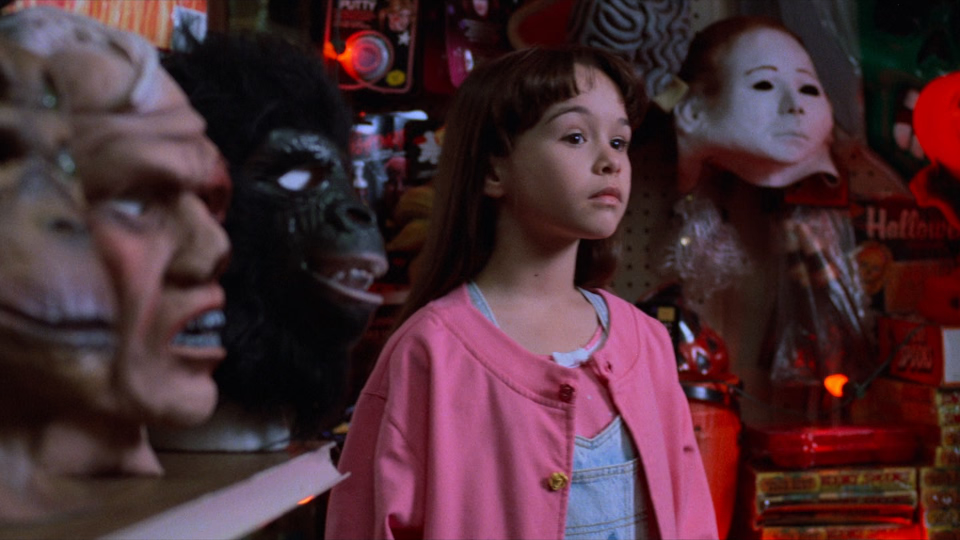
He is after his niece. Laurie Strode has died offscreen, leaving a daughter named Jamie, about eight, played by Danielle Harris. Jamie lives with a foster family and has nightmares about her uncle. Given the family history, the nightmares show good sense. Her foster sister Rachel, played by Ellie Cornell, has been ordered to cancel her Halloween date and take Jamie trick-or-treating, and Michael steals a tow truck to get to them.
I mention the tow truck because it’s the last time Michael seems to need one. Later he picks up the ability to be in two places at once. He is on a roof, and a moment later he steps out of the shadows beside the house. The girls flee, break into the school, run the length of the hallway, turn a corner, and there he is, as if he’d been waiting since the first bell. The director, Dwight H. Little, has said he saw this as a straight serial-killer picture with nothing supernatural about it. So why did Michael need the truck? I’m guessing he wanted the radio.
The movie was made in a hurry, and it shows. John Carpenter and Debra Hill, who made the original, had developed their own sequel without Michael, and when producer Moustapha Akkad insisted on bringing him back, they sold their interest and walked away. Akkad had money and a release date but no script and no director. Alan B. McElroy was given eleven days to write the screenplay before the 1988 writers’ strike. Jimmy Sangster, a British screenwriter, used to ask producers whether they wanted it good or wanted it Tuesday. Akkad wanted it Tuesday.
That explains the dialogue, which sounds like a first draft nobody had time to read aloud. Jamie overhears Rachel grumbling about babysitting and apologizes for ruining everything, and her foster father turns on Rachel with a speech about how the little girl needs all the love they can give her. A reaction shot of each girl would have said as much and spared both actresses. Later, fleeing the school, Rachel finds a cop. “He’s inside!” she says. “Where?” he asks. “In the school!” I can’t decide who the film thinks is slower, the cop or the audience.
Michael himself looks underfunded. George P. Wilbur, who plays him in the mask, wore hockey pads under the coveralls, and the result is a torso shaped like a water heater. The mask looks like a knockoff from a drugstore bin, too clean and too loose. In one scene Michael has blond hair, because, as Little admits in his audio commentary, the correct mask went missing.
As Loomis, Donald Pleasence brings his usual weary dignity, but the script uses him so generically that I suspect McElroy was writing around the chance he wouldn’t sign. His burn scars grow and fade from scene to scene, since the makeup was changed partway through the shoot and nothing could be reshot. His best moment is a ride with an itinerant preacher who is cheerfully expecting the apocalypse. The two of them seem to get along.
Then there’s the roof. Rachel and Jamie climb out onto it, Michael follows, and Little never cuts to a wide shot from the ground. We never feel the height or get the image the scene is asking for, of Michael against the night sky, and within a minute you know you’re on a soundstage. Carpenter shot in the wide Panavision frame and used it to put Michael at the edge of an ordinary street, standing still in a way people don’t. Little shoots in the narrower 1.85 frame, and his Michael pops out from behind corners like the skeleton in a fun house.
There are pleasures. It has the decency to run under ninety minutes. The Salt Lake City locations give the small town a good autumn chill, although Haddonfield seems to have drifted south since 1978, given how quickly the local men form a posse with pickups and shotguns and a general tailgate mood. Beau Starr, as the new sheriff, plays every scene as if he’s been dealing with this town for years and has stopped expecting it to behave. Harris is very good, a child actor who never seems to be acting, and the movie should have trusted her more. It keeps shuffling between Jamie, Rachel and Loomis instead, and Jamie’s nightmares, which could have colored the whole film the way the dreams did in Phantasm, come out as a couple of jump scares.
The movie has its admirers, and I suspect many first saw it on videotape at about Jamie’s age, when a Michael who came after little kids instead of babysitters was the scariest idea in the world. If that’s you, this may be your Halloween, and nothing here will change your mind. The final scene, which I won’t reveal, is the best idea in the picture, and Halloween 5 found it too inconvenient to keep. Watch this one the same week as Carpenter’s original, though, and you’ll see what a few more Tuesdays might have bought.