Hack-O-Lantern

About two-thirds of the way into Hack-O-Lantern, during a Halloween party, the camera drifts out to the street, where one of the guests starts telling jokes. The others form a circle around him. The camera stays, and stays, until you realize you are watching a stand-up comic do his act, with no bearing on the plot and no explanation. I can’t remember a single joke. I laughed anyway, because somebody decided this belonged in a movie about a satanic cult.
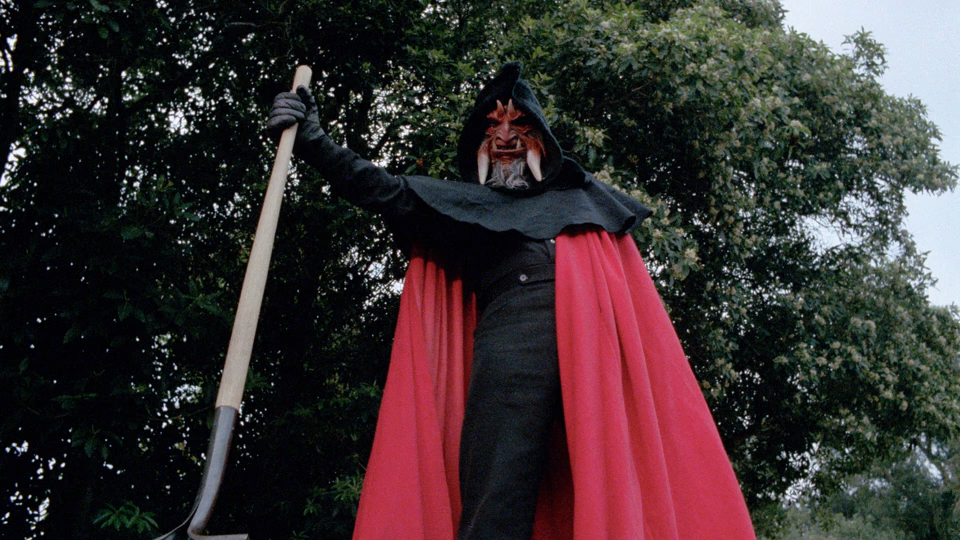
The cult is run by Grandpa, played by Hy Pyke, who chews the scenery like a man who has figured out the director can’t stop him. Grandpa presides over his corner of rural California and wants his grandson Tommy initiated. Tommy is a grown man who dresses like a roadie for a metal band and sulks like a 16-year-old denied the car keys. His mother, Amanda, and his younger brother, Roger, a cop, try to straighten him out. Meanwhile someone in a devil mask is killing the people around Tommy, and we are invited to wonder whether Tommy has already gone over to the dark side or Grandpa is clearing the way for him.
As Tommy, Gregory Scott Cummins has the unsettling look of Andrew Robinson, the Scorpio killer in Dirty Harry, with eyes a little too large and a little too far apart, but his performance edges into parody. If you had to explain the 1980s slasher-movie bad boy to someone who had never seen one, you could show them Tommy, shirtless, angrily lifting weights, and be done.
The commentary track by producer Raj Mehrotra clears up a great deal. Mehrotra says he wanted a rip-off of John Carpenter’s Halloween, commissioned a script and hired Jag Mundhra, an Indian director who had no idea what Halloween was. Mundhra brought in his own writer and reshaped the story. He spoke little English, which Mehrotra gives as the reason the actors seem to be following different sets of directions.
Mehrotra also explains the musical number, which I had taken for a music video that wandered in from MTV. Tommy dreams he is attacked by a woman with a trident while a band plays behind them. Indian movies have songs, so Mundhra added one, and the woman is Kali slaying a demon. I doubt anyone told the band.
It is a sleazy movie. The nudity, topless and full-frontal, arrives in such quantity that you stop noticing it, the way you stop hearing a refrigerator. Adult-film star Jeanna Fine, billed as Angel Rush, turns up for a small part as Tommy’s bad-girl bedmate, complete with a pentagram branded onto her backside. She seems comfortable in front of the camera, which places her above much of the cast. And the movie, for its part, is too goofy to leave you wanting a shower.
It was shot in 1986 and released in 1988, and hardly a scene goes by without a headband, a Walkman or a haircut to remind you of the date. What startles me each time I see it is how good it looks. The exteriors take in the rolling California hills with compositions that would hold up in a studio picture. The interiors are dark and moody, and the rituals are drenched in a red that suggests someone on the crew had been watching Italian horror. Nobody will mistake it for early Argento, but it looks better than Halloween 4: The Return of Michael Myers, which came out the same year. Hack-O-Lantern is more fun, too.
Sure, the plot is flimsy and the mystery of the devil mask holds less interest than the comedian. But if you’d like to see what happens when a man makes a movie he doesn’t fully understand, and makes it with complete sincerity, Hack-O-Lantern has delirium to spare. A by-the-numbers Halloween knockoff would have been forgotten by 1989. Mehrotra wanted one and hired the wrong man to make it, and I’m grateful to both of them.