Bodies Bodies Bodies

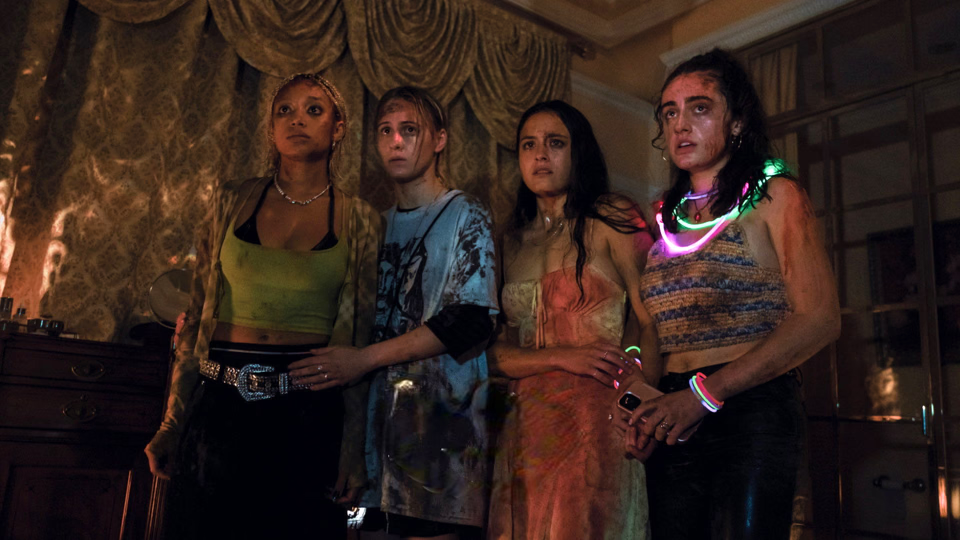
A hurricane is coming, so the young people in Bodies Bodies Bodies lock themselves in a mansion with tequila, cocaine, and a party game in which someone is secretly the murderer and everyone else must figure out who. The game requires lying. The drugs encourage it. When a real corpse appears with its throat slit, the group discovers it has spent the entire evening rehearsing for exactly this and is still no good at it.
Halina Reijn, a Dutch actress turned director, has made a very funny film about a generation that has replaced experience with performance. These kids don’t argue with each other, they argue at each other for the benefit of the room. Somebody’s parents paid for somebody’s rehab; somebody once said something at a party in 2019; somebody has a podcast.
The dialogue is the film’s great pleasure. One character announces, with the conviction of a woman quoting scripture, “Feelings are facts!” Another corrects her: “No, facts are facts.” When a friend clamps a hand over her mouth to stop her screaming for help and giving away their position to a possible murderer, Rachel Sennott emerges wounded to the soul: “You’re silencing me!” She delivers it like a woman who has never once in her life been wrong about anything.
When the hurricane knocks out the power, the kids use their phones as flashlights but keep the screens on too. It’s a practical solution to a lighting problem and also the truest image in the movie. These people cannot navigate a dark hallway without also checking whether they are being perceived.
My complaint is that Reijn keeps flinching. She has built a comedy about horrible people and then wants you to like somebody. That somebody is Bee, played by Maria Bakalova, an outsider of Eastern European origin who works shifts at the Game Hut. She’s brought along by her new girlfriend Sophie. The moment Bee arrives, a sharp satire of a whole generation softens into a familiar story about poor girl among rich Americans. We’re invited to hate these people for their money rather than for their artifice. Bee is written as a device. She gets courage when the plot needs courage and goes quiet the rest of the time.
We are asked to invest in her romance with Sophie, but the film never shows us what either woman sees in the other. Sophie says she loves her in the opening scene. That’s the evidence. Everyone else in the house is treated as a joke about people who mistake vocabulary for character. A braver film would have put the lovers in the joke too.
The soundtrack is a missed opportunity. Reijn has said the music came from her cast, and you can hear the anxiety of a director in her forties asking twenty-three-year-olds what’s cool. The opening drive is scored to announce the film’s youth. Haneke dropped a John Zorn grindcore track over the credits of Funny Games and made your skin crawl before anything happened. A wrong song would have served this material better than a right one.
Still, I laughed too hard and too often to be stingy. It plays like the American remake of a better European film that was never shot. But the one we got is sharp and mean, and it ends on a nihilistic punchline that had me cackling in the dark.