Allegheny Uprising

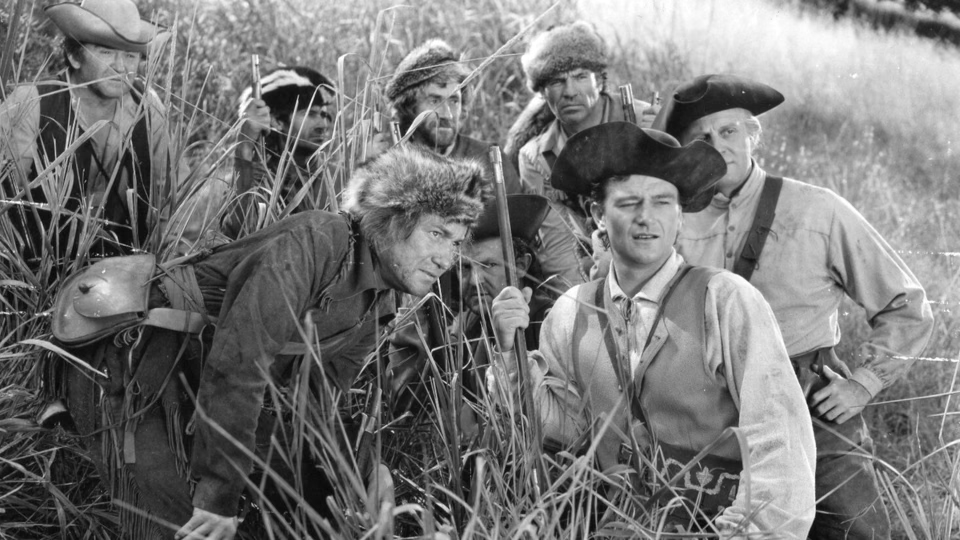
John Wayne’s first line in Allegheny Uprising is “Tripe!” He says it with the drawl that would later call James Stewart “Pilgrim,” and it doesn’t belong under a tricorn hat. Wayne made a career out of the American past, but his past begins somewhere around the Alamo.
He plays James Smith, a Pennsylvania frontiersman at the close of the French and Indian War, frustrated that local merchants are selling rum and rifles to the Delawares, who then, fortified by the rum, use the rifles on the settlers. Smith and his neighbors petition the governor for troops, and the governor sends them Captain Swanson, played by George Sanders, which is like calling an exterminator and getting a cat who hates you. Swanson fails to notice that the merchants are still smuggling their goods west, now labeled as military supplies. So Smith and his men put on war paint and raid the wagons themselves, and a warrant follows, and then a standoff at the fort.
Sanders is the best thing in the picture after Wayne. He regards the colonists with the expression of a man who has been served the wrong wine and intends to have the vineyard court-martialed. Brian Donlevy, as a merchant heavy, brings his usual well-fed menace, and the two of them make a more convincing pair of villains than the movie deserves.
Claire Trevor gets top billing and a part that seems to have been inflated to justify it. She plays the daughter of an Irish tavern keeper, and her function is to keep trying to join the raids so Wayne can keep sending her home. We know she is hot-tempered because she shouts every line, including the ones that don’t need shouting, which is most of them. Trevor was 29 and is playing a girl of perhaps 19, so her schoolgirl crush on Wayne lands somewhere between awkward and baffling. The two had real chemistry in John Ford’s Stagecoach earlier the same year. Here they seem to be standing near each other for the benefit of the poster.
That poster is the key to the whole enterprise. RKO was plainly hoping to bottle a little Stagecoach lightning, and its method was to take a B-picture script and pour money on it. There is location shooting, a full fort, and crowds of extras. But the screenplay still thinks like a programmer: it parks Wayne offstage for long stretches to reach feature length, it has no big action set piece, and it ends with a courtroom scene staged in what I am fairly sure is the tavern set with the furniture rearranged. Along the way it reaches for melodrama it hasn’t earned, as when Trevor announces she will protect her man even if she has to shoot her own father. She shouts that, too.
The seams show elsewhere. The Indians wear their mohawks on bald caps that bunch up around the ears. The colonists advance on the fort under cover of a mist smeared on the camera lens. The exteriors are handsome, but they are also unmistakably California, where the hills have the sunburned look of land that has never met a Pennsylvania winter.
Still, I didn’t hate it. Wayne may be in the wrong century, but 1939 was the year he became a star, and this movie proves Stagecoach was no accident. He knows how to walk into a thin scene and make it seem to have a floor under it. For his admirers, the verdict is simple enough. If you have sat through the Monogram westerns of the mid-1930s, including the one where he played “Singin’ Sandy” and someone else’s voice came out of his mouth, this is a step up. With a better script, this cast could have made something worth remembering.