Alien³

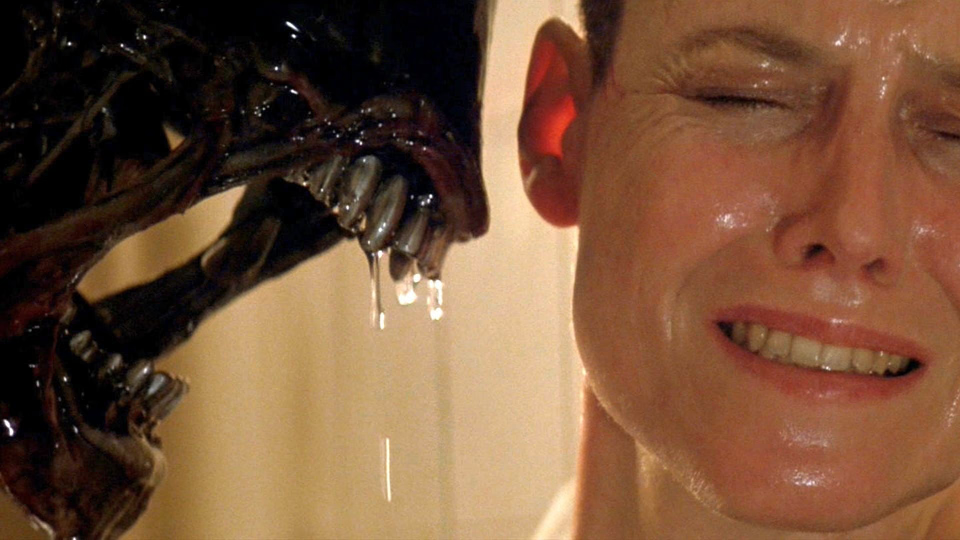
Alien 3 begins by killing Newt and Corporal Hicks, the two people Ripley fought hardest to save in Aliens. It does this during the opening credits, while they are still asleep in their hypersleep pods, which spares the actors the trouble of showing up.1 A fire breaks out aboard their ship, the computer ejects the pods, and the escape vehicle crashes on a planet called Fiorina 161. Sigourney Weaver’s Ripley is the only survivor. I suppose the filmmakers wanted a clean slate. What they cleared away was the audience’s goodwill, and the movie spends the next two hours showing no interest in earning it back.
Fiorina is a foundry and a prison for violent male offenders, murderers and rapists mostly. It was built for thousands. It has been decommissioned, and about two dozen inmates have stayed behind voluntarily, for reasons that come down to the screenplay needing victims. They have taken up an apocalyptic religion, which in practice means they are bald and say ominous things. Ripley shaves her head too, because of lice. In 1992 the haircut got more attention than the movie, and it may still be the most original idea in it.
Something has come down with Ripley, of course. It gestates inside a dog, bursts out on four legs, and begins working its way through the population. This is where the film runs into a problem it never solves. Apart from Clemens, the prison doctor, played by Charles Dance with a weary intelligence that seems to belong to a better movie, the men are unpleasant and interchangeable, and worst of all they are dull. When the creature took one, I often had to wait for the next scene to learn who had just died.
The screenplay is by Walter Hill, David Giler, and Larry Ferguson, and it is an Idiot Plot, which is Roger Ebert’s term for a story that would be over in twenty minutes if everyone weren’t an idiot. Ripley wants an autopsy on Newt and wants both bodies burned. Asked why, she suggests cholera. She has spent two films learning exactly what an alien parasite does, and she can’t bring herself to say the words. The warden warns that a woman’s presence could be dangerous to his men’s fragile emotional state, and in the next scene she is eating lunch with them in the mess hall. Surely a prison built for thousands had a spare room. Ripley, who was working a loading dock in the last picture, now revives a shattered android with the confidence of a field engineer. She also invites Clemens to bed with a directness I did not expect from a woman who has just cremated a child. You might wonder whether the writers had seen the earlier films, until you remember that Hill and Giler produced them.
In 1992, I blamed the director, David Fincher, a newcomer from music videos who seemed to be drowning. He has since made Seven, Fight Club, and The Social Network, and I owe him an apology. The film’s virtues are nearly all his. He soaks it in sepia, the color of a nicotine stain, and fills the gray sets with fog, steam, and shadow until the corridors seem to rot as you watch. Early on, his camera pirouettes among the prisoners during their introduction, as if hoping one of them will turn out to be interesting. He is manufacturing atmosphere from a script that offers none.
He could not do much about the alien. Because it runs on four legs, it could not be a man in a suit in the long shots, as it was in the first two films, so it is a rod puppet filmed separately and composited into the footage. It has no weight and is lit wrong, and it never seems to occupy the same room as the people it is chasing. Ray Harryhausen was compositing creatures into live action thirty years earlier, and his skeletons in Jason and the Argonauts had more presence. Alien 3 arrived one year after Terminator 2 poured a man out of liquid metal, and one year before Jurassic Park. The Terminator 2 comparison hurts the most, because James Cameron directed Aliens and set the bar this film had to clear. The ending, with a sacrifice in a vat of molten metal, echoes Cameron’s Terminator 2 finale and invites the comparison all over again. The most memorable images in the last act, racing point-of-view shots down the corridors after fleeing convicts, come from Sam Raimi’s The Evil Dead, which cost what this production probably spent on fog.
The producers took the picture away from Fincher and recut it themselves, and he disowned the result. In 2003 a “Special Edition” was assembled from his footage, running two hours and twenty-five minutes. Fincher would not take part, and given the stories of executives second-guessing him and pages being rewritten daily on the set, I don’t blame him. Still, it is the better version. The creature now emerges from an ox, an effect filmed but never finished in 1992 and completed with computer animation for the home video release. That afterthought looks better than any optical effect in the theatrical cut. A subplot is restored for Paul McGann’s Golic, a disturbed inmate the other prisoners avoid, who is found covered in blood eating cereal in the mess and later frees the creature because he believes it is a god. That at least explains why he disappears from the theatrical version without a word.
The longer cut keeps its share of foolishness. After the alien kills a staff member, one inmate is left alone in the corridor to mop up the blood. Either the others have never heard of the buddy system, or they have decided that a clean floor is the priority while a monster lives in the ventilation. I would have voted for survival. Add a half star if you are watching the 2003 version.
Footnotes
-
Michael Biehn, though, reportedly insisted on being paid for the five-second use of his likeness on a computer screen. Good for him. ↩︎