A Blade in the Dark

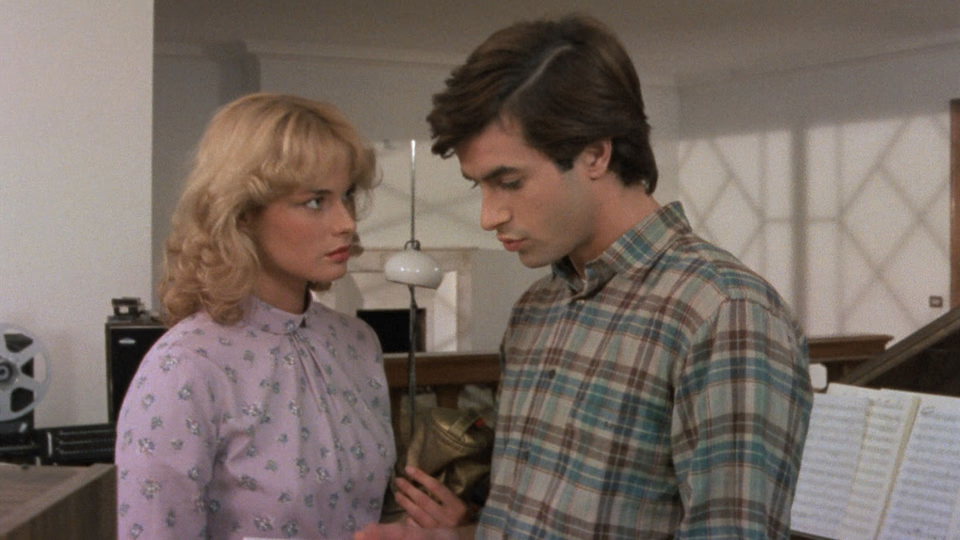
A Blade in the Dark was born of real estate. Producer Luciano Martino had a villa. He told his screenwriter to set a movie there. Think of the savings. The result plays like a tax write-off with murders.
Andrea Occhipinti plays Bruno, a composer hired to score a horror film. He moves into the villa for peace and quiet. He gets neither. Women keep showing up—one materializes in his closet, which the movie presents without irony—and then they disappear. A killer is lurking. Bruno investigates, slowly, the way a man walks through a house when the script needs to fill time.
The screenplay was structured for Italian television in four 25-minute episodes, each capped with a murder. When it proved too violent for censors, it was trimmed to 97 minutes for theaters. This explains the episodic feel. It does not excuse it.
But this is far from the film’s only problem. Consider one sequence. Bruno wanders into the backyard and stops mere feet from the killer, who is crouching behind a bush. There’s a body at Bruno’s feet but he doesn’t look down and apparently missed it as he approached. The killer begins extending a box cutter—click, click, click—and Bruno does not hear it. But he does hear a telephone ringing inside the house a moment later.
He goes back inside to find the place ransacked, blood on the basement stairs. Does he call the police? He does not. Later, when asked why, he explains that without bodies, the police would think him crazy. This is the logic of a man in a movie that cannot afford police uniforms.
The villa itself is a problem. White walls. Tiled hallways. Sparse furniture. It has the atmosphere of a model home on a slow Sunday. The corridors are interchangeable, but not in the uncanny way Kubrick made the Overlook interchangeable. In the way that modern construction is just modern construction. You half expect a realtor to walk through the door.
Occhipinti deserves better. He has genuine charisma and he convinces as a composer, which is harder than it sounds.
Any horror fan will guess the twist after the first act and identify the killer not long after. They may second-guess themselves, thinking, “It couldn’t possibly be so lazy.” It is. The climax does contain one moment of authentic pleasure: Bruno clocks the killer in the head with a brick. I laughed out loud. It is the film’s only real surprise.
The English dub provides its own entertainment. In one scene, a woman screams about a spider in the closet. “Oh, that’s just a cockroach,” Bruno assures her. We can clearly see a spider. Later, a character watches the horror film Bruno is scoring and remarks, “That little boy is a good actor.” The boy is Giovanni Frezza, who played Bob in The House by the Cemetery. Nobody involved in this production was checking anybody else’s work.
A Blade in the Dark is a film assembled from savings, not inspiration. It has one good performance and one good brick. That is not enough.