Mandy

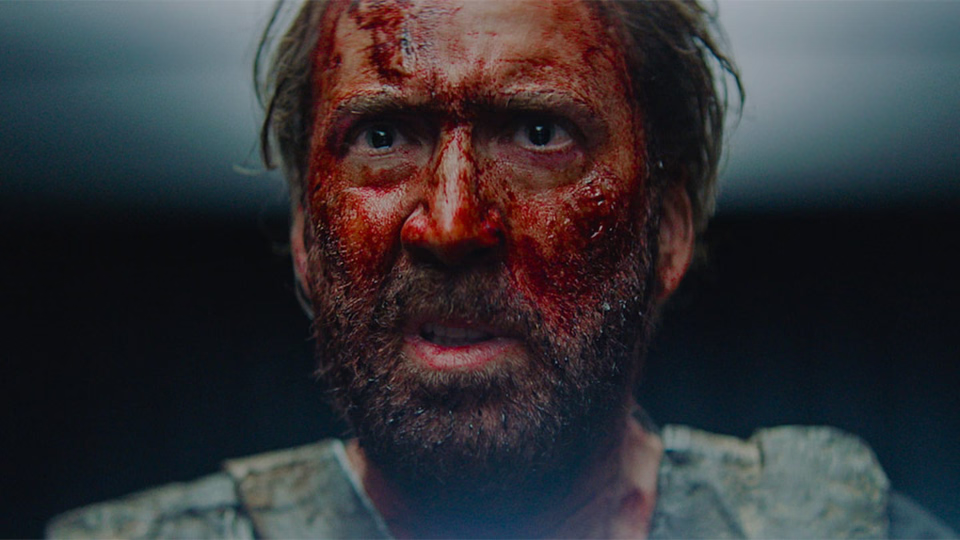
There is a scene about halfway into Mandy in which Nicolas Cage, alone in a bathroom in his underwear, drinks vodka straight from the bottle and screams. He screams for a long time. The camera does not flinch and neither does he. I have seen a great many grief scenes, and most of them are more tasteful than this one. None of them are more primal.
The plot can be summarized in a sentence. A cult takes a man’s girlfriend and the man goes and gets her back, in the only way left to him. That description fits a hundred revenge-o-matics, but Panos Cosmatos, who directed and co-wrote, is interested in none of them.
He sets the film in 1983, in mountains somewhere in the Pacific Northwest, and the year is not decoration. Red Miller drives home from the logging job and Ronald Reagan is on the radio, talking about moral decay in America. Red turns the knob. This tells you whose side the movie is on: it belongs to the airbrushed van art, the Frazetta paintings, the album covers that terrified church groups back when terrifying church groups was easy work.
Cosmatos builds his world the way Lynch does, by suggestion and by refusing to explain. Red and Mandy live in a cabin of odd-angled glass with the forest pressing in on every side, and after a bad dream Red says he wonders if they shouldn’t move away from this place. We wonder too. Andrea Riseborough plays Mandy with a scar through one eye and a stillness that suggests she has already survived something the film declines to tell us about. When the cult’s leader wants her, his lieutenant blows something called the Horn of Abraxas, which looks like a chunk of cooled lava and summons a gang of demon bikers on quads who could have ridden in from Hellraiser. A man called the Chemist cooks acid in the wilderness and keeps a tiger. Red’s journey leads him to a mountain tunnel full of molten springs and cars half buried in the earth. Where he emerges, the geography has stopped obeying anyone.
This is dark fantasy more than horror, Robert E. Howard updated, with the evil sorcerer as a Manson-esque failed folk singer and the barbarian as a lumberjack with a chainsaw and body armor. Cosmatos gels everything in red and black until the screen looks like Suspiria transplanted to an old-growth forest, and the interstitial titles appear in fonts last seen on the spinner rack at a drugstore. He also stops the movie cold for a commercial about a macaroni-and-cheese mascot that vomits cheese onto children. I laughed out loud, and I could not tell you why it belongs there, only that it does.
Cage is the reason the second half works. His sad, careful eyes in the early scenes belong to a man astonished by his own luck. Later, his history of glorious excess means we believe him when he snorts enough cocaine to kill a bear, forges an axe that belongs on a gatefold sleeve, and crushes a skull with his bare hands. Another actor would have to earn that turn. Cage arrives pre-approved.
The score, by Jóhann Jóhannsson, who died before the film opened, is a wall of distorted low guitar that moves like weather. It does for this picture what Frizzi did for Fulci, only heavier and more epic.
Mandy is one of the strangest, most committed pieces of American filmmaking of the last decade. Whether you should see it depends on your tolerance for a two-hour movie with a long setup in which shots dissolve languidly into one another and the plot routinely dips into the surreal. Viewers who want their revenge pictures lean will find it interminable. But for those of us with a fondness for nihilistic Italian horror, dark fantasy paperbacks, and chainsaw duels, Cosmatos has handed us something we have wanted for decades without knowing to ask.