Hellraiser

Early in Hellraiser, Larry Cotton and two movers are wrestling the marital mattress up a narrow staircase. Larry is at the top, walking backward, and his hand is headed for an exposed nail. Clive Barker cuts between this and Larry’s wife, Julia, remembering an afternoon tryst with Larry’s brother, Frank, until the lovers and the movers are grunting and heaving to the same rhythm. Then the nail does its work. Larry wanders in, the color of paste, holding out his bleeding hand like a waiter presenting a bad bottle of wine, and announces he is about to faint. Julia regards him the way you would regard a muddy dog on the good carpet.
That sequence tells you most of what you need to know about the movie. It is wry and lewd at the same time, and it ends in blood. The blood drips through the floorboards of an upstairs room where Frank once played with a puzzle box and was taken apart for his trouble. It brings him back, more or less. What returns is a skeleton with a few strands of muscle and a short list of needs, all of them wet.
Frank needs blood, and Julia agrees to get it. She picks up lonely men in bars, brings them home, and introduces them to a claw hammer. Larry’s daughter, Kirsty, eventually notices that her stepmother’s gentlemen callers never seem to leave, and her snooping leads her to the puzzle box and the beings Frank escaped from.
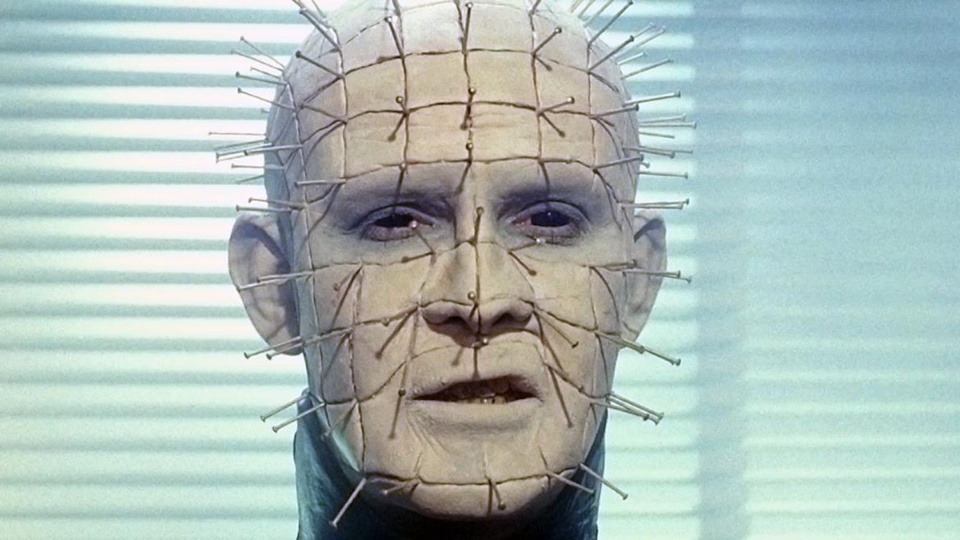
Those are the Cenobites, and they are why the film has sequels and a thousand Halloween costumes. Watching it again, I was surprised at how little of the movie belongs to them. They don’t arrive until about an hour in, and their leader, the one played by Doug Bradley with the nails in his head, has maybe eight minutes on screen. Barker spends those minutes well. The walls of the house stop behaving like walls, and hooks on chains come out of the dark looking for flesh to tear. The Cenobites hold no grudge against anyone. They call themselves demons to some and angels to others, and they speak with the calm of hotel concierges who have seen every kind of guest.
The real monsters are Frank and Julia, who have mistaken appetite for love, but Barker doesn’t scold them. He doesn’t have to. As Julia, Clare Higgins is the best thing in the film. Her eyes are polite and empty around Kirsty, cold around Larry, and hungry around Frank. The role could slide into camp without much of a push. She plays it straight and never raises her voice, which is scarier.
Andrew Robinson, who played the Scorpio killer in Dirty Harry, has a different challenge as Larry. For most of the picture he’s a man who would apologize to a nail. Later, when someone else is wearing his skin, Robinson finds a grin that somehow seems to contain more teeth. Barker admits on the commentary track that the two of them did not get along. A veteran actor, a first-time director, and no money will do that. None of the friction shows.
There is gore enough for anyone, but what stays with you is the design: the box, the leather, the sense that hell has a dress code. A few jump scares are tossed off like jokes, and the best one involves a statue of Jesus. I will say no more. Not everything works. A creature in the final scene asks more of the budget than the budget had, and looks it.
If you’re squeamish, you already know this isn’t your evening. If you like horror that would rather disturb you than make you jump, Hellraiser is just as visceral as it was in 1987. Barker wanted you to think about what pleasure costs, and he made sure you’d wince while you did the math.